Careers

Benefits of Cold Room Panels for Food Storage Industries

Introduction

If you run a cold store, a dairy or a food processing unit, you probably watch two numbers more closely than any others: your monthly electricity bill and the stock you had to throw away.

Both often trace back to the same place. It isn’t usually the compressor or the cooling unit. It’s the walls and ceiling around them. When insulation is weak or joints leak, warm air gets in, the refrigeration system works harder, and temperatures drift just enough to cost you product, money and, at times, a clean FSSAI inspection.

Cold room panels are built to stop that. Each panel has a dense PUF or PIR foam core bonded between two metal sheets. It’s made in a factory and locked tightly to the next panel on site. The result is a cold room that holds its temperature, uses less power, stays easy to clean and grows with your business.

In this guide, you’ll see what those benefits look like in real numbers, where panels can fall short, and how to choose the right thickness and finish for the food you store.

The Real Benefits of Cold Room Panels for Food Storage

Temperatures that don’t drift

Ask any cold storage operator about their worst day, and it usually involves a temperature alarm. Panels prevent most of those days. The foam core runs unbroken across every wall and ceiling, so heat has nowhere to slip through, whether you’re running a +4°C dairy chiller or a −25°C freezer full of ice cream.

A smaller electricity bill, every single month

Your compressor only works as hard as your walls force it to. With well-insulated panels, less heat gets in, the compressor switches off sooner, and it rests longer between cycles. That shows up on your power bill, and it adds years to the life of your refrigeration equipment.

Walls your hygiene team will thank you for

Plaster soaks up spills, holds moisture and grows mould in the corners. Metal-faced panels don’t. A quick wipe or wash-down leaves them clean, which makes daily sanitation faster and FSSAI inspections far less stressful.

Insulation that stays dry for years

Water is the silent enemy of every cold room. When humid air seeps into insulation, it condenses, and performance quietly drops month after month. Panels are sealed in metal on both sides with tight joints, so moisture stays out, even through a coastal monsoon.

Up and running in weeks, not months

Brick cold rooms mean masonry, curing time, plastering and then insulation. Panels skip all of that. They arrive cut to size and lock together on site, so you start storing stock and earning revenue much sooner.

Less waste, more stock you can sell

Every temperature swing costs you something: ice crystals in frozen food, soft vegetables, a rejected batch of milk. Steady conditions keep produce, meat, dairy and seafood fresh for longer. Fewer losses mean healthier margins and fewer awkward calls from customers.

A cold room that grows with you

Business doubles next year? Add more panels. Need a separate freezer zone? Put in a partition. Moving to a bigger site? In many cases, you can take the room apart and rebuild it there. Try doing that with brick walls.
Enquire with Alfaa Panels on WhatsApp

How to Choose the Right Panels for Your Cold Room

Thickness: start with the temperature

Thickness is where most of the money goes, and where most mistakes happen. Go too thin and you pay for it on every electricity bill. Go too thick and you’ve tied up capital you won’t get back.

Room type Typical temperature Common starting thickness (PUF/PIR)
Cold room (meat, fish on ice, short-term holding) +0°C to +10°C 60 mm
Chiller (fruit, vegetables, dairy, beverages) +5°C to -5°C 80 mm
Freezer (frozen foods, ice cream, frozen meat) −5°C to −18°C 100–150 mm
Blast freezer −30°C to −40°C 150–200 mm

Facings

PPGL or PPGI covers most packaged food storage. Aluminium is lighter and copes better with salty coastal air. Stainless steel is the one to pick for meat, fish, dairy processing and any room that gets washed down.

Don’t forget the floor

A chiller can often sit on an existing concrete floor, depending on the temperature and how the room is used. A freezer is a different story. It needs insulation under the floor as well as on the walls, and a freezer built at ground level usually needs some heating below that insulation. Without it, moisture in the soil can freeze and push the slab upward, a problem called frost heave (BFBi). Cracked floors and racks that are no longer level are expensive to fix, so plan the floor together with the panels.

Doors and the ante room

The door is the biggest opening in the room, and it’s open a lot. For freezers, use insulated doors with heated frames so they don’t freeze shut, and add strip curtains or an air curtain at busy entrances.

FSSAI’s checklist also mentions an ante room kept below 4°C for picking frozen goods (FSSAI). It’s worth having for its own sake, because it stops a rush of warm, wet air every time the freezer door opens.

Planning a Cold Room? Talk to Us First

Alfaa Panels has been making insulated sandwich panels since 1992, with manufacturing plants in Hosur (2), Ahmedabad (2), Raipur, Karnal and Pune. Being closer to your site means shorter transport times and quicker support.

Our cold room wall and ceiling panels come with double tongue-and-groove or camlock joints and a choice of PPGL, PPGI, aluminium or stainless steel facings. We also supply matching cold room doors and corner panels.

Tell us your room size, the temperature you need and where you’re based. We’ll suggest the right thickness, core and facing for what you store. Request a quote or message us on WhatsApp.

Frequently Asked Questions

What are the main benefits of cold room panels?

They hold temperatures steady, cut refrigeration energy use, give you walls that are easy to clean, keep moisture out of the insulation, go up faster than brick and can be extended later.

What thickness do I need for a food freezer?

For freezers running at −18°C to −25°C, PUF or PIR panels of around 100–150 mm are a common choice. The right figure depends on outside temperature, sun exposure, how often the door opens and a proper heat-load calculation.

Is PUF or PIR better for cold storage?

Both insulate very well. PIR is usually preferred where fire performance matters. PUF is widely used and good value for most chillers and freezers. Whichever you choose, check the fire test certificate for the exact panel on offer.

Will cold room panels make my facility FSSAI compliant?

They help with the physical side: holding chilled food at 5°C or below, frozen food at −18°C or below, and keeping rooms clean and free of mold. Compliance also depends on your temperature records, cleaning schedule and daily practices.

Can panels go on my existing floor?

For a chiller, often yes, once the floor has been checked. A freezer usually needs an insulated floor and, at ground level, underfloor heating to prevent frost heave. Ask your supplier to inspect the floor before quoting.

How long do cold room panels last?

With intact skins, sealed joints and regular cleaning, panels can last for many years. Service life depends on the facing, site conditions and physical damage, so get the warranty terms in writing.
What is the difference between cold storage and a cold room?

Introduction

People mix up these two terms all the time, even people who have spent years in the food or pharma trade. A dairy owner calls a supplier asking for “cold storage” when all he needs is one chilled room, maybe 12 by 10 feet, to keep milk and paneer overnight. Someone else asks for “a cold room” for 800 tonnes of potatoes, which is actually a full cold storage plant with five or six chambers, a loading bay and a generator room.

It sounds like a small language issue, but it isn’t. Quotes come back for the wrong scale, budgets get made on the wrong numbers, and weeks go by before anyone realises what was actually meant.

So in this post we’ve tried to explain it simply. What a cold room is, what cold storage is, why the insulation in both quietly decides your electricity bill, and how you can work out which one your business needs.

What Is a Cold Room?

A cold room is basically one insulated room that is kept cold by a refrigeration unit. If you’ve ever walked into the back of a supermarket or a hotel kitchen and felt the temperature drop suddenly, you were probably standing in one.

These days most cold rooms are made from insulated sandwich panels (PUF or PIR core between two steel sheets). A high-quality Cold Room Panel helps maintain consistent internal temperatures and reduces heat transfer. The panels come to site ready-made and are locked together using cam locks, a bit like a large, very heavy puzzle. Then the door goes on, the condensing unit is fitted outside, and the evaporator is fixed inside on the ceiling. Small ones can be 6 ft × 6 ft. Bigger ones go up to a few thousand square feet, and quite often they sit inside a building that already exists.

Types, based on temperature

Type Usual temperature Typically stores
Chiller room +2°C to +8°C Fruits, vegetables, milk and dairy, soft drinks, vaccines
Freezer room -18°C to -25°C Meat, chicken, fish, ice cream, frozen snacks
Blast freezer -35°C to -40°C Freshly cooked or processed food that has to freeze fast before going into storage

Who actually uses them

Hotels and restaurants, supermarkets, hospitals and blood banks, medicine distributors, bakeries, florists, small food processing units. Mostly, it’s businesses that need a fair amount of stock kept cold right next to where they use it every day.

Why people go for them

Mainly speed and cost. Once the panels reach site, a small panel cold room can be put up within a few days, and it costs a fraction of what a proper facility does. The other advantage people don’t think about at first is that it’s modular. If business grows you can add panels and make it bigger, and if you move premises you can open it up and shift the whole thing.

What Is Cold Storage?

When people in the trade say “cold storage”, they usually mean the whole facility, not one room. It’s a building made to hold large quantities of perishable goods at controlled temperatures for weeks, sometimes months.

Inside, you’ll normally find several chambers, each set to its own temperature. Then there’s everything around them: an anteroom so warm air doesn’t rush in every time a door opens, loading docks with dock shelters, pallet racking, a DG set for power cuts, and a monitoring system that alerts someone when a temperature drifts. The building is often a pre-engineered steel structure, with insulated panels on the roof and walls and an insulated floor below.

Take a typical multi-commodity cold store near a mandi. Potatoes might be kept in one chamber at 2 to 4°C, apples in another at around 0°C, and frozen peas in a third at -20°C. Each of those chambers is really a cold room. Put them together with the docks and systems, and you have cold storage.

One more difference people notice when they get quotes: a cold room is talked about in feet or cubic metres, while a cold storage project is talked about in metric tonnes or pallet positions.

Who uses cold storage

FPOs and farmer cooperatives, exporters, large food processors, pharma and vaccine distributors, quick-commerce and online grocery companies, and 3PL operators who rent out space to many customers.

If you want one line to remember: a cold storage facility is made up of cold rooms, but a single cold room on its own isn’t cold storage.

Side-by-side comparison

Point Cold room Cold storage
What it is One insulated room A full facility, usually with many chambers
Size From 6 × 6 ft up to a few thousand sq ft Large; capacity counted in tonnes
Temperatures Normally one Different temperature per chamber
How long goods stay Days, sometimes weeks Weeks to months
Time to build A few days to a few weeks Several months
Cost Lower Much higher
Used by Hotels, hospitals, shops, small processors Cooperatives, 3PLs, exporters, big processors

Why Insulation Matters in Both Systems

A lot of buyers spend most of their time comparing compressors and refrigeration brands. Fair enough, but the compressor only produces the cold. Whether that cold stays inside the room or leaks out through the walls depends on the panels.

In Indian conditions this gets serious quickly. Think of a freezer room in Nagpur or Ahmedabad in May. Outside the wall it’s 42°C, inside it’s -20°C, so the panel is holding back a difference of more than 60 degrees for hours on end. If the insulation is weak, the compressor keeps running, the electricity bill goes up month after month, and the temperature inside keeps going up and down. Those ups and downs are what spoil the product and cut shelf life, more than most people expect.

Things worth checking before you order panels

Core material. PUF is what most cold rooms use, because it gives very good insulation for its thickness and the price is reasonable. PIR insulates about as well but behaves better in a fire, so bigger facilities, pharma clients and insurance companies are increasingly asking for it.

Thickness. Roughly speaking, chiller rooms use 60 to 80 mm panels, freezer rooms 100 to 150 mm, and blast freezers 150 mm or more. Don’t just pick a number though. It depends on your inside temperature, the climate at site and how many times a day the door will open, so ask your supplier to work it out.

Density, and whether it’s even. A decent PUF core is around 40 kg/m³, and it should be the same across the whole panel. Panels foamed by hand sometimes have hollow pockets inside, and you won’t know until that spot starts sweating.

Joints. Cam-lock and tongue-and-groove joints need to close tight. Even a small gap lets heat in, causes condensation, and over time builds up ice, usually in a corner nobody checks.

Doors and floor. Good panels can’t make up for a bad door. Choosing a reliable cold room doors manufacturer is equally important for maintaining proper insulation. Check the gaskets, make sure freezer doors have heater strips, and use strip curtains. Freezer rooms also need an insulated floor, otherwise the ground underneath can freeze over time and push the floor slab up.

At Alfaa, one of the established sandwich panel manufacturers in India, we make our cold room panels on fully automated continuous lines, so the core density and thickness stay the same from the first panel to the last one. And since our plants are in Hosur, Ahmedabad, Raipur and Karnal, the panels usually don’t have to travel very far to reach your site.

Enquire with Alfaa Panels on WhatsApp

How to Choose Between a Cold Room and Cold Storage

The easiest way to decide is to stop thinking about what it’s called and look at how your business actually works. These are the questions we’d suggest asking yourself.

How much will you store, and how quickly does it move? If it’s a few tonnes that go out within the week, a cold room will do the job. If you’re holding hundreds of tonnes for months, say potatoes from harvest until the off-season, you’re looking at cold storage.

Does everything need the same temperature? If yes, one room may be enough. If you’re keeping dairy and frozen chicken under one roof, you’ll need separate chambers, and that starts moving you towards a facility.

Is the space for you, or for customers? Plenty of people plan to rent space to farmers, traders or brands. That’s a cold storage business, and it needs docks, racking, proper monitoring and a building of its own.

What space do you have right now? A cold room can go inside an existing shed, factory or kitchen. Cold storage normally needs its own land.

How soon do you need it, and what’s the budget? A cold room can be working within days or a few weeks. A cold storage project usually takes months once you add planning, approvals and construction.

What will things look like in three years? If you expect to grow, plan for it now. Panel rooms can be extended later, and a cold storage layout can leave space for extra chambers.

To put it very simply: if you run a restaurant, hotel, hospital, shop, pharmacy distribution or a small processing unit, a cold room is usually the right fit. If you handle farm produce in bulk, export, process food at large scale or want to run warehousing for others, you need cold storage.

If you’re still in two minds, just send our team your product, how much you handle in a day, the temperature you need and your site location. We’ll suggest a layout and panel spec that fits, and give you a quote based on your actual numbers.

Summary

A cold room is a single insulated room kept at a set temperature. Cold storage is a full facility with several such rooms, built to hold large quantities for longer periods. The right choice depends on how much you store, for how long, and at how many temperatures.

In both cases, well-made insulated panels are what keep the temperature steady and running costs low. If you’re unsure what your project needs, the Alfaa Panels team is happy to help.

FAQs

What is the purpose of a cold room?

A cold room keeps perishable goods like food, dairy, meat and medicines at a steady low temperature, so they stay fresh longer and less stock goes to waste.

At what temperature is cold storage maintained?

That depends on what’s being stored. Fruits, vegetables and dairy are usually kept somewhere between 0°C and +8°C, and frozen food at -18°C or below. In a bigger facility, each chamber may run at a different temperature.

PUF or PIR, which panel is better for a cold room?

Both do a good job of insulating. PUF costs less and is the most widely used. PIR is the safer choice where fire performance matters, for example in large facilities, pharma projects, or where the insurer or fire department asks for it.

How thick should freezer room panels be?

For a freezer at around -20°C, 100 to 150 mm panels are common. Blast freezers need thicker ones. The exact thickness should be worked out from your temperature, your location and how the room will be used.

Can I shift or enlarge a cold room later?

Yes. Since panel cold rooms are joined with locks, you can add more panels to make the room bigger, or take it apart and put it back up somewhere else.

PIR Sandwich Panels for Roofing: Benefits, Thickness and Applications

The roof of a factory or warehouse takes the full impact of the weather. During summer, it is often the largest source of heat entering the building. During rain, every joint and flashing is tested. Choosing the roofing sheet alone is therefore not enough; the insulation beneath it matters just as much.

PIR sandwich panels solve both requirements in a single product. Each panel has a rigid insulated core enclosed between metal sheets, so the roof covering and insulation are installed together. For industrial projects that need good thermal insulation and improved fire performance, this can be a sensible roofing option.

Does Alfaa recommend PIR panels for roofing?

Yes. Alfaa recommends PIR roof panels for projects where insulation and improved fire performance are both important. They are commonly considered for factories, warehouses, PEB structures, food-processing facilities and temperature-controlled buildings.

PIR is not required for every roof. Some buildings may be adequately served by PUF panels. Others may have a fire-performance requirement written into the project specification. The correct choice comes down to how the building will be used, the temperature expected inside and the technical requirements set by the project team.

PIR versus PUF: where does the difference matter?

PIR and PUF belong to the same family of rigid foam insulation, but their formulations are different. Under high heat, PIR is designed to form a charred surface layer. This characteristic gives it better fire performance than standard PUF and is the main reason it is selected for projects with more demanding fire requirements.

Still, the core cannot be judged on its name alone. The metal facing, joint detail, fasteners and installation all contribute to the performance of the finished roof. Test reports and the specified fire classification should be checked before a product is approved.

For a closer comparison of both materials, see Alfaa’s guide to the PIR panel vs PUF panel difference.

What are the main benefits of PIR roofing panels?

  1. Better control over heat: On a large industrial building, even a small improvement in roof insulation can make a noticeable difference indoors. The PIR core slows heat passing through the roof, helping factories and warehouses maintain steadier internal conditions.
  2. Improved fire performance: PIR is often chosen when fire behaviour forms part of the design brief. This does not make every PIR panel “fireproof.” The panel must have the correct test evidence, and the complete roof system must match the classification required for the project.
  3. Quicker work at site: The insulation is already enclosed within the panel. There is no need to install a separate roof sheet and then add another insulation layer below it. Fewer stages can mean faster progress, particularly across large PEB and warehouse roofs.
  4. Lower weight: PIR sandwich panels provide insulation without adding excessive dead load. Their relatively low weight also makes handling easier. Panel span, support spacing and fastening details must nevertheless follow the approved structural design.
  5. Reduced cooling load: When less heat enters from above, air-conditioning or refrigeration equipment has less heat to remove. The actual energy saving will vary because no two buildings operate in exactly the same way. Climate, working hours, airtightness and equipment efficiency all have an influence.
  6. Protection from the weather: Once installed correctly, the outer metal sheet protects the building from sun, wind and rain. Good workmanship is critical around ridges, gutters, laps and roof penetrations. Many water-entry problems begin at these details rather than in the panel itself.
  7. Simple routine maintenance: PIR panels have factory-finished surfaces and no exposed insulation layer. Maintenance usually centres on checking fasteners, sealants, flashings and drainage points at regular intervals. 

Which PIR roof panel thickness should be used?

Alfaa offers PIR roofing panels from 30 mm to 100 mm. Rather than selecting a panel only from the building name, it is better to start with the actual temperature and insulation requirement.

  • 30 mm: For basic roof insulation where close temperature control is not needed.
  • 40 mm: For light-industrial buildings with a moderate insulation requirement.
  • 50 mm: Frequently considered for factories and warehouses that need a dependable insulated roof.
  • 60 mm: For projects requiring greater resistance to heat transfer.
  • 80 mm: For buildings where internal temperature control has a stronger influence on operations.
  • 100 mm: For higher insulation needs, including suitable cold storage and refrigerated-building roofs.

These are useful application guides, not fixed rules. A warehouse in a hot region may not have the same requirement as a similar building in a milder climate. Cold storage is more specific again, because the target room temperature has a direct effect on the insulation calculation.

Before confirming the thickness, review the project location, roof design, required thermal performance and operating temperature. Alfaa’s PIR roof panel page provides further product information.

Where are PIR roof panels commonly used?

  1. Factories: Industrial roofs often cover a large area and receive direct heat throughout the day. PIR panels help insulate production and assembly areas while forming the external roof surface.
  2. Warehouses and logistics centres: Stored goods and people working inside a warehouse can both be affected by excessive heat. An insulated roof reduces heat gain and helps keep the interior more manageable.
  3. Pre-engineered buildings: PIR panels suit many PEB projects because they are light and can be installed efficiently over large spans. The panel and supporting structure should be designed as a coordinated system.
  4. Food-processing units: Temperature has a direct bearing on many food-handling and processing activities. PIR roofing can form one part of the insulated building envelope, helping reduce external heat entering the work area.
  5. Cold storage and refrigerated buildings: Any heat entering a refrigerated space adds to the work done by the cooling plant. PIR panels can be used for the roof, with the required thickness determined by the operating temperature and thermal design. Suitable cold room panels should also be selected for the walls and ceilings.
  6. Pharmaceutical and controlled-environment facilities: For these projects, the roof cannot be considered separately from the rest of the building envelope. Panel joints, interfaces and internal finishes must all meet the relevant project requirements.
  7. Commercial and public buildings: PIR panels are also useful where an insulated roof, clean internal finish and shorter installation period are required in one system.

What does Alfaa consider before recommending a PIR panel?

The first question is not simply, “How thick should the panel be?” It is, “What does this building need the roof to do?”

For a factory, working temperature and fire requirements may lead the discussion. For a warehouse, the stored material and local climate may matter more. In a cold storage facility, operating temperature and refrigeration load become central to the decision. PEB projects also need close coordination between panel span, profile and the supporting structure.

This project-by-project approach avoids both under-specifying the roof and paying for insulation that the building does not need.

Final word

PIR sandwich panels are worth considering when an industrial roof has to provide more than weather protection. They bring insulation, improved fire performance and finished metal surfaces into one roofing element.

The thickest option is not automatically the best choice. A panel performs well when its thickness, profile, joints and installation suit the actual building. Alfaa recommends reviewing these details together before the roof specification is finalised.

Planning a factory, warehouse, PEB or temperature-controlled facility? Contact to Alfaa Panelsabout the PIR roof panel suited to your project.

Frequently asked questions

Why does Alfaa recommend PIR roof panels?

Alfaa recommends PIR when a roof needs thermal insulation along with improved fire performance. Their lightweight construction and faster installation also make them practical for many industrial and PEB projects.

Are PIR panels completely non-combustible?

No. PIR panels offer improved fire performance, but they should not be described as completely fireproof. Always check the test report and fire classification of the proposed product.

Is 50 mm suitable for factories and warehouses?

It is a commonly considered thickness for these buildings, but it is not suitable for every project by default. Climate, roof design and the required thermal performance must be reviewed first.

Can 100 mm PIR panels be used for cold storage roofing?

Yes, 100 mm may be considered where higher roof insulation is needed. The final selection should be based on the required operating temperature and the project’s thermal calculations.

Are PIR roof panels suitable for PEB structures?

Yes. They are lightweight and can be installed efficiently over large roof areas. Structural loading, panel span and fastening arrangements must be approved as part of the PEB design.

Cold Room Panels for Dairy Processing Unit PUF Insulated Panel Solutions

Introduction

A dairy processing unit needs strict temperature control, clean production areas, and reliable insulation to protect milk and milk-based products. Products like milk, curd, paneer, cheese, butter, cream, yogurt, and ice cream are highly sensitive to heat, moisture, and contamination.

This is why cold room panels for dairy processing units play an important role in modern dairy infrastructure. PUF insulated cold room panels help maintain controlled temperatures, reduce refrigeration load, support hygiene, and improve energy efficiency.

For dairy businesses, the right panel system is not just a construction material. It directly impacts product freshness, shelf life, electricity cost, hygiene, and long-term plant performance.

What Are Cold Room Panels for Dairy Processing Units?

Cold room panels are insulated sandwich panels used to build temperature-controlled rooms for dairy processing, storage, packaging, and dispatch. These panels usually have a rigid insulation core between two metal sheets.

For dairy applications, PUF insulated panels are widely preferred because they provide excellent thermal insulation and help maintain stable internal temperatures.

They are commonly used in:

  • Milk chilling rooms
  • Dairy processing rooms
  • Paneer production areas
  • Cheese storage rooms
  • Butter and cream storage
  • Ice cream freezer rooms
  • Packaging rooms
  • Finished product cold storage
  • Temperature-controlled dispatch areas

Why Dairy Processing Units Need PUF Cold Room Panels

Dairy products can spoil quickly if temperature control is not maintained. Heat gain inside a cold room increases the load on refrigeration systems and affects product quality.

PUF cold room panels create a strong insulated envelope for the dairy facility. This helps reduce outside heat entry and keeps the internal temperature stable.

For dairy plant owners, this means:

  • Better product freshness
  • Longer shelf life
  • Lower spoilage risk
  • Reduced electricity consumption
  • Better hygiene control
  • Faster installation
  • Long-term operating savings

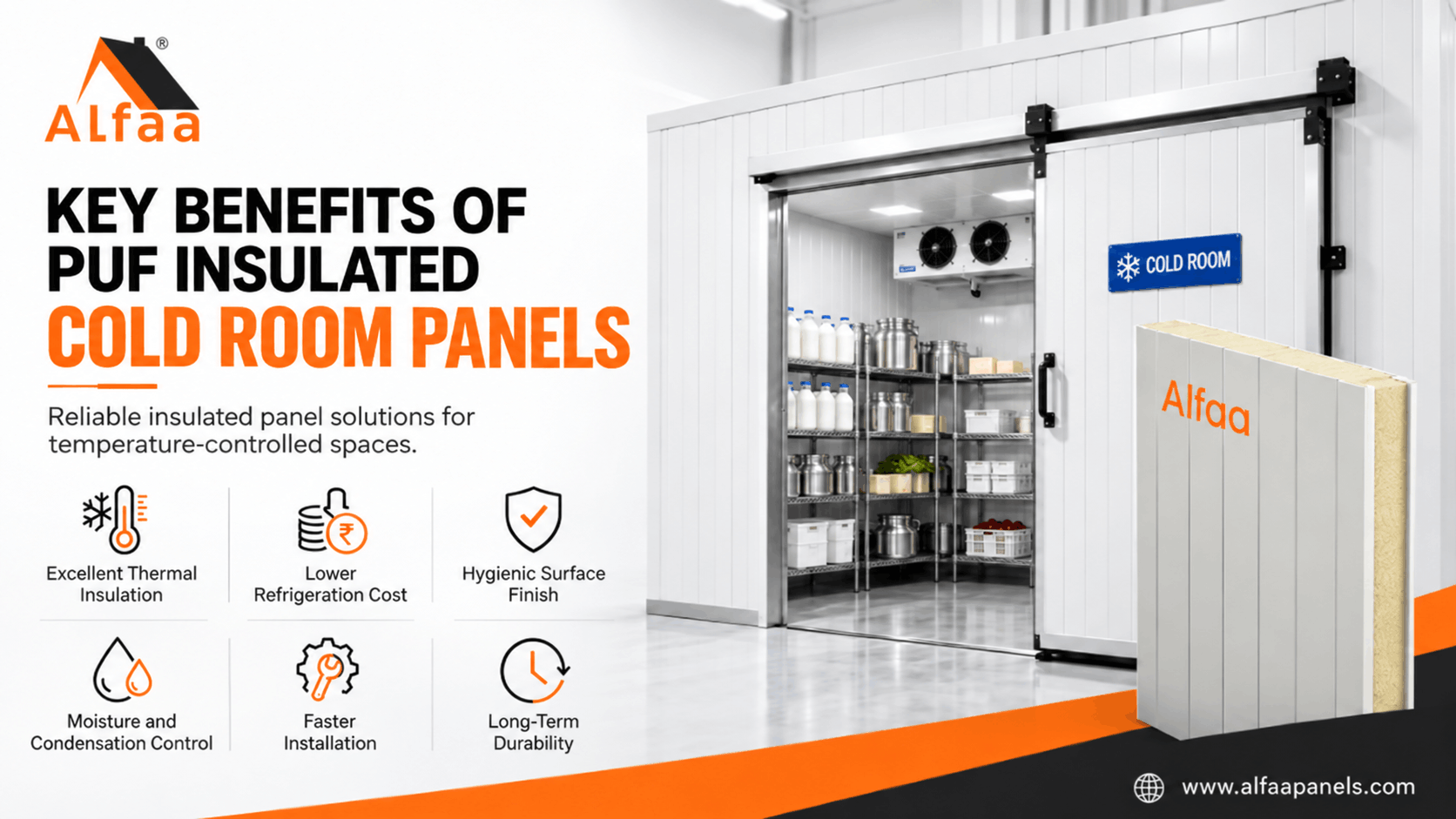
Key Benefits of PUF Insulated Cold Room Panels

Excellent Thermal Insulation

PUF panels have strong insulation properties. They help maintain chilled and frozen temperatures inside dairy cold rooms. This is important for milk, paneer, cheese, butter, yogurt, and ice cream storage.

Lower Refrigeration Cost

When heat transfer is reduced, the refrigeration system does not need to work continuously at high load. This helps reduce compressor running time and lowers electricity cost.

Hygienic Surface Finish

Dairy processing units require clean and washable surfaces. Cold room panels have smooth metal surfaces that are easy to clean and maintain, supporting food-grade hygiene requirements.

Moisture and Condensation Control

Dairy plants often have high humidity and frequent washing. Properly installed PUF panels help reduce condensation, moisture issues, and hygiene-related problems.

Faster Installation

PUF panels are prefabricated and modular. This makes cold room construction faster than traditional brick wall construction.

Long-Term Durability

Good-quality insulated panels are designed for continuous industrial use. They offer long service life when installed with proper joints, sealants, and accessories.

Applications in Dairy Processing Units

Milk Chilling Rooms

PUF panels help maintain chilled temperatures for raw milk storage before processing.

Paneer and Cheese Processing Areas

Temperature-controlled rooms help protect product texture, quality, and freshness.

Butter and Cream Storage

Cold room panels help maintain consistent cooling for fat-based dairy products.

Ice Cream Freezer Rooms

Frozen dairy products require low-temperature storage, usually with thicker insulated panels.

Packaging Rooms

Insulated panel rooms help maintain clean and controlled conditions during final product packing.

Finished Product Cold Storage

PUF cold room panels help preserve dairy products before dispatch and distribution.

Recommended Panel Thickness for Dairy Cold Rooms

Dairy Application Suggested Panel Thickness
Dairy processing area 50 mm to 60 mm
Milk chilling room 80 mm
Dairy cold storage 80 mm to 100 mm
Paneer / cheese storage 80 mm to 100 mm
Frozen dairy storage 100 mm to 150 mm
Ice cream freezer room 120 mm to 150 mm

The final thickness should be selected based on room temperature, room size, refrigeration design, and product type.

PUF Panels vs Traditional Construction

Factor PUF Cold Room Panels Traditional Brick Construction
Thermal insulation High Low to moderate
Installation speed Fast Slow
Hygiene Better Needs additional finishing
Energy efficiency High Lower
Maintenance Low Higher
Expansion Easier Difficult
Long-term operating cost Lower Higher

For dairy processing units, PUF insulated panels are usually more practical because they combine insulation, wall finish, and faster construction in one system.

Why Choose Alfaa Panels for Dairy Cold Room Panels?

Alfaa Panels provides insulated panel solutions for cold rooms, clean rooms, food processing, dairy processing, and industrial applications.

With industry expertise since 1992, pan-India manufacturing presence, BIS-certified products, and in-house NABL testing, Alfaa Panels offers reliable PUF and PIR insulated panels for temperature-controlled facilities.

Alfaa Panels cold room panels are suitable for:

  • Dairy processing units
  • Milk chilling centers
  • Food processing plants
  • Cold storage facilities
  • Ice cream plants
  • Clean and hygienic industrial rooms

For dairy businesses, Alfaa Panels helps deliver panel solutions focused on insulation, hygiene, durability, and long-term performance.

Conclusion

Cold room panels are essential for modern dairy processing units. They help maintain stable temperatures, reduce energy costs, improve hygiene, and protect dairy product quality.

PUF insulated cold room panels are one of the best choices for dairy plants because they offer strong thermal insulation, fast installation, clean surfaces, and long-term durability.

For milk chilling, paneer production, cheese storage, butter storage, ice cream freezing, and dairy cold storage, Alfaa Panels provides dependable insulated panel solutions for temperature-controlled dairy infrastructure.

FAQs: 

1. What are cold room panels for dairy processing units?

Cold room panels for dairy processing units are insulated sandwich panels used to build temperature-controlled rooms for milk, curd, cheese, butter, paneer, ice cream, and other dairy products. These panels help maintain stable internal temperatures by reducing heat transfer from outside.

2. Why are PUF insulated panels suitable for dairy plants?

PUF insulated panels are suitable for dairy plants because they provide excellent thermal insulation, reduce refrigeration load, support hygiene, and help maintain product freshness. They are commonly used in milk chilling rooms, processing rooms, dairy cold storage, and freezer areas.

3. What are the benefits of PUF cold room panels in dairy processing units?

PUF cold room panels provide temperature stability, energy savings, hygienic surfaces, faster installation, moisture resistance, and long service life. For dairy owners, this means lower running costs and better product protection.

4. Where are cold room panels used inside a dairy plant?

Cold room panels are used in milk chilling rooms, raw milk storage areas, curd and yogurt rooms, paneer rooms, cheese processing rooms, butter storage rooms, ice cream freezer rooms, packaging rooms, and finished product cold storage.

5. What is the ideal panel thickness for dairy cold rooms?

The ideal thickness depends on the room temperature. Processing areas may use 50–60 mm panels, chilled dairy rooms generally use 80–100 mm panels, and freezer or ice cream storage areas may require 120–150 mm panels.

6. Are PUF panels better than brick walls for dairy cold rooms?

Yes. PUF panels are better than brick walls for dairy cold rooms because they provide built-in insulation, faster installation, smoother hygienic surfaces, and better temperature control. Brick walls usually need extra insulation and finishing.

7. How do PUF cold room panels reduce electricity costs?

PUF panels reduce electricity costs by minimizing heat transfer into the cold room. When less heat enters, the refrigeration system works less, reducing compressor load, power consumption, and long-term operating cost.

8. Are PUF cold room panels hygienic for dairy products?

Yes. PUF cold room panels have smooth, easy-to-clean surfaces that support hygienic dairy operations. They help reduce dust, moisture buildup, and contamination risk when properly installed and maintained.

9. Can PUF panels be used for milk chilling rooms?

Yes. PUF panels are widely used for milk chilling rooms because they help maintain stable chilled temperatures. This supports milk freshness, reduces spoilage risk, and improves refrigeration efficiency.

10. Can cold room panels be used for ice cream plants?

Yes. Cold room panels are suitable for ice cream plants, especially freezer rooms, hardening rooms, and frozen storage areas. Ice cream storage usually requires thicker insulated panels and proper sealing to maintain low temperatures.

11. What is the difference between PUF and PIR panels for dairy plants?

PUF panels offer excellent thermal insulation and cost-effective cold room performance. PIR panels also provide insulation but offer better fire performance, making them suitable for dairy projects where enhanced is required.

12. Why is airtight joint design important in dairy cold rooms?

Airtight joints prevent warm air leakage, temperature loss, condensation, and higher refrigeration load. A proper joint system helps maintain stable cooling and improves energy efficiency inside dairy cold rooms.

13. What surface finish is best for dairy cold room panels?

For dairy cold rooms, the surface should be smooth, washable, corrosion-resistant, and hygienic. Common options include pre-painted galvanized steel, stainless steel, or food-grade coated metal sheets depending on cleaning and project requirements.

14. Why choose Alfaa Panels for dairy cold room panel solutions?

Alfaa Panels offers PUF and PIR insulated cold room panels for dairy, food processing, cold storage, and industrial applications. With industry expertise since 1992, pan-India manufacturing presence, BIS-certified products, and in-house NABL testing, Alfaa Panels provides reliable insulated panel solutions for temperature-controlled dairy facilities.

15. Which cold room panel is best for dairy plants?

For most dairy plants, PUF insulated cold room panels are one of the best choices because they provide strong thermal insulation, hygiene, fast installation, energy savings, and long-term durability. For projects requiring higher fire performance, PIR panels can also be considered.

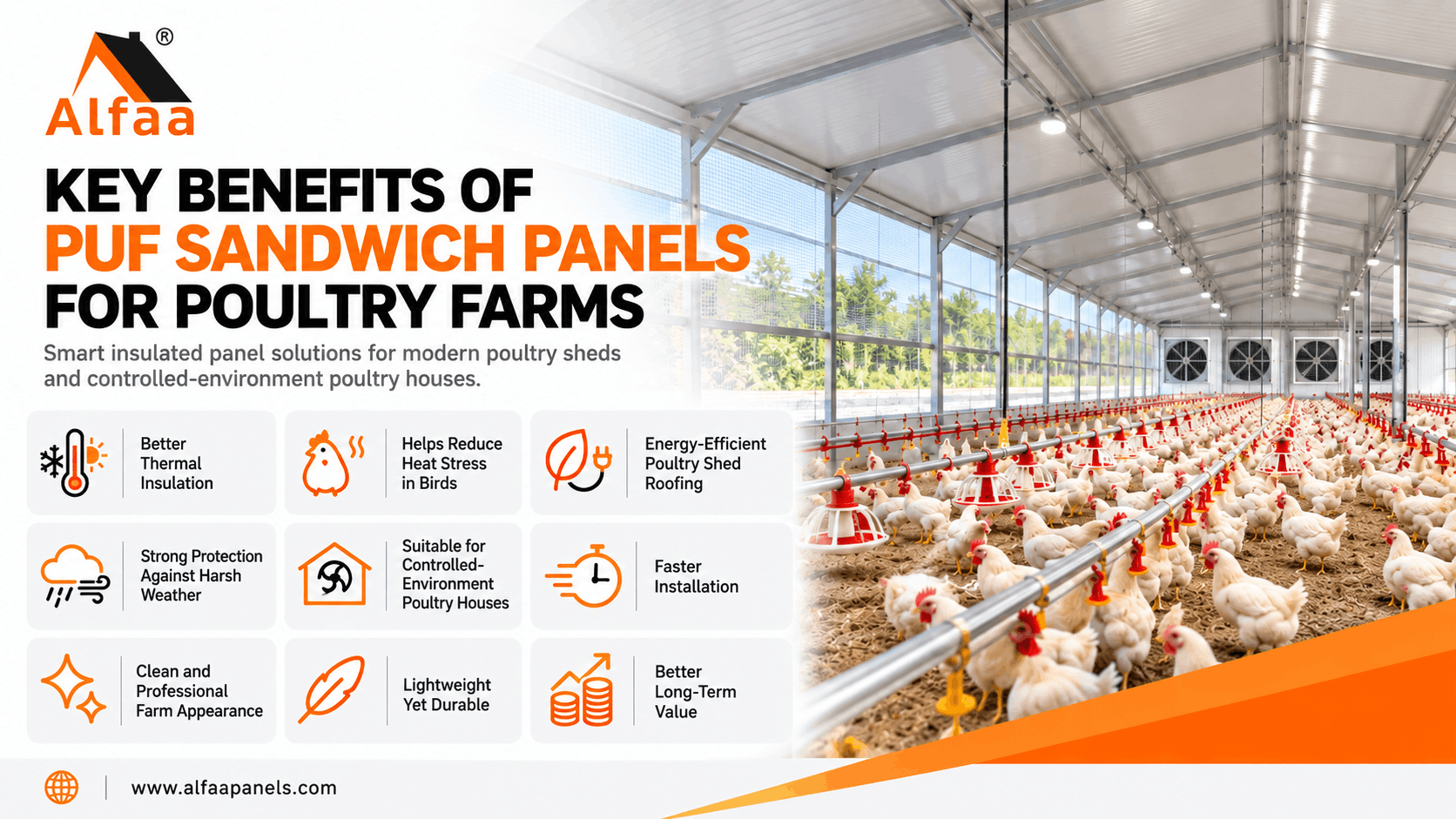
PUF Sandwich Panels for Poultry Farms

PUF sandwich panels are one of the best roofing and wall panel solutions for poultry farms because they help maintain a cooler, cleaner, and more controlled shed environment. In poultry farming, temperature, ventilation, hygiene, and building durability directly affect bird comfort and farm productivity. A poorly insulated shed can become extremely hot during summer, uncomfortable during weather changes, and expensive to cool.

PUF sandwich panels solve this problem by combining a durable metal sheet surface with a high-performance polyurethane foam core. This insulated core reduces heat transfer through the roof and walls, helping poultry houses maintain better indoor conditions.

For broiler farms, layer farms, breeder farms, hatcheries, and controlled-environment poultry houses, Alfaa Panels offers high-quality insulated sandwich panel solutions designed for long-term performance.

What Are PUF Sandwich Panels?

PUF sandwich panels are factory-made insulated panels made with a polyurethane foam core bonded between two metal sheets. The outer metal sheets provide strength and weather protection, while the PUF core provides thermal insulation.

In simple words, a PUF sandwich panel works like a protective insulated shield for the poultry shed. It helps reduce outside heat from entering the building and supports a more stable indoor temperature.

PUF panels are commonly used for:

  • Poultry farm roofing
  • Poultry shed wall cladding
  • Controlled-environment poultry houses
  • Hatchery buildings
  • Feed storage rooms
  • Farm utility buildings
  • Insulated partitions
  • Agricultural and industrial sheds

Why Poultry Farms Need Insulated Roofing

The roof is one of the biggest sources of heat gain in a poultry farm. Traditional metal sheets absorb heat quickly and transfer it inside the shed. This increases internal temperature and puts more pressure on fans, cooling pads, foggers, and ventilation systems.

Birds are highly sensitive to heat stress. When the shed becomes too hot, birds may reduce feed intake, drink more water, become less active, and experience poor growth or reduced laying performance.

Insulated roofing helps reduce this problem. PUF sandwich roof panels reduce heat transfer and support better temperature control inside the poultry house.

That is why modern poultry farm owners are moving from normal roofing sheets to insulated PUF sandwich panels.

Why Are PUF Sandwich Panels Ideal for Poultry Farms?

PUF sandwich panels are ideal for poultry farms because they provide thermal insulation, structural durability, faster installation, better hygiene, and long-term energy efficiency. They help poultry sheds stay more comfortable during summer, monsoon, and winter conditions.

For poultry farm owners, this means better bird comfort, improved farm environment, and reduced dependence on continuous cooling.

Key Benefits of PUF Sandwich Panels for Poultry Farms

Better Thermal Insulation

The main benefit of PUF sandwich panels is thermal insulation. The polyurethane foam core reduces heat transfer from outside to inside.During hot summer months, this helps keep the poultry shed comparatively cooler. During colder periods, it helps reduce sudden temperature loss. This creates a more balanced environment for birds.For poultry farms, stable temperature is not a luxury. It is a basic requirement for better bird performance.

Helps Reduce Heat Stress in Birds

Heat stress is one of the biggest challenges in poultry farming. It can affect bird health, feed conversion, growth rate, egg production, and mortality levels.PUF roof panels help reduce roof heat transfer, which supports a more comfortable shed environment. When used with proper ventilation, PUF panels can help create better living conditions for birds.This is especially important for broiler farms and layer farms in hot Indian climates.

Energy-Efficient Poultry Shed Roofing

Poultry farms often depend on cooling systems such as exhaust fans, foggers, cooling pads, and air circulation systems. If the roofing is not insulated, cooling equipment has to work harder.PUF sandwich panels reduce external heat entry, which can lower the cooling load. Over time, this can support better energy efficiency and reduce operational costs.For large poultry farms, even small improvements in energy efficiency can make a big difference.

Strong Protection Against Harsh Weather

Poultry farms face multiple weather challenges throughout the year:

  • High summer heat
  • Heavy monsoon rain
  • Strong winds
  • Humidity
  • Winter temperature variation

PUF sandwich panels provide a durable roofing and wall solution for these conditions. The metal sheet surface protects the structure, while the insulated core improves internal comfort.With proper installation, PUF roof panels can help create a stronger and more reliable poultry shed.

Suitable for Controlled-Environment Poultry Houses

Controlled-environment poultry farming requires better control over temperature, humidity, ventilation, and air movement. PUF sandwich panels are highly suitable for such projects because they support insulated building construction.When combined with proper ventilation design, cooling pads, fans, and farm automation systems, PUF panels help improve environmental control inside the poultry house.This makes them a smart choice for advanced poultry farming projects.

Faster Installation

PUF sandwich panels are factory-made and supplied in ready-to-install form. This reduces site work and speeds up construction.For poultry farm owners, faster installation means:

  • Quicker project completion
  • Less labour dependency
  • Reduced construction delays
  • Faster farm operation
  • Cleaner site execution

This is useful for both new poultry farm projects and expansion of existing farms.

Clean and Professional Farm Appearance

Modern poultry farms need clean, well-planned, and professional infrastructure. PUF sandwich panels give poultry sheds a neat and modern appearance compared to traditional roofing and wall systems.The clean surface finish also helps create a better-looking farm environment, which is useful for commercial farms, integrated poultry projects, and export-focused operations.

Lightweight Yet Durable

PUF sandwich panels are lightweight compared to many traditional construction materials. This helps reduce load on the structure while still providing strength, insulation, and durability.For poultry shed construction, lightweight panels can make structural planning easier and more cost-effective.

Better Long-Term Value

Normal roofing sheets may look cheaper initially, but they do not provide insulation. In hot climates, this can increase cooling requirements and affect bird comfort.PUF sandwich panels provide better long-term value because they combine roofing, insulation, durability, and energy-saving benefits in one system.For serious poultry farm owners, this makes PUF panels a better investment.

PUF Sandwich Panels vs Normal Roofing Sheets for Poultry Farms

Feature Normal Roofing Sheets PUF Sandwich Panels
Thermal insulation Low High
Heat reduction Poor Better
Bird comfort Depends heavily on ventilation Supports better comfort
Cooling load Higher Lower
Energy efficiency Limited Better
Installation speed Moderate Fast
Appearance Basic Modern and professional
Long-term value Lower Higher
Suitable for controlled poultry farms Limited Highly suitable

PUF sandwich panels are a better option when poultry farm owners want insulation, durability, faster installation, and better temperature support.

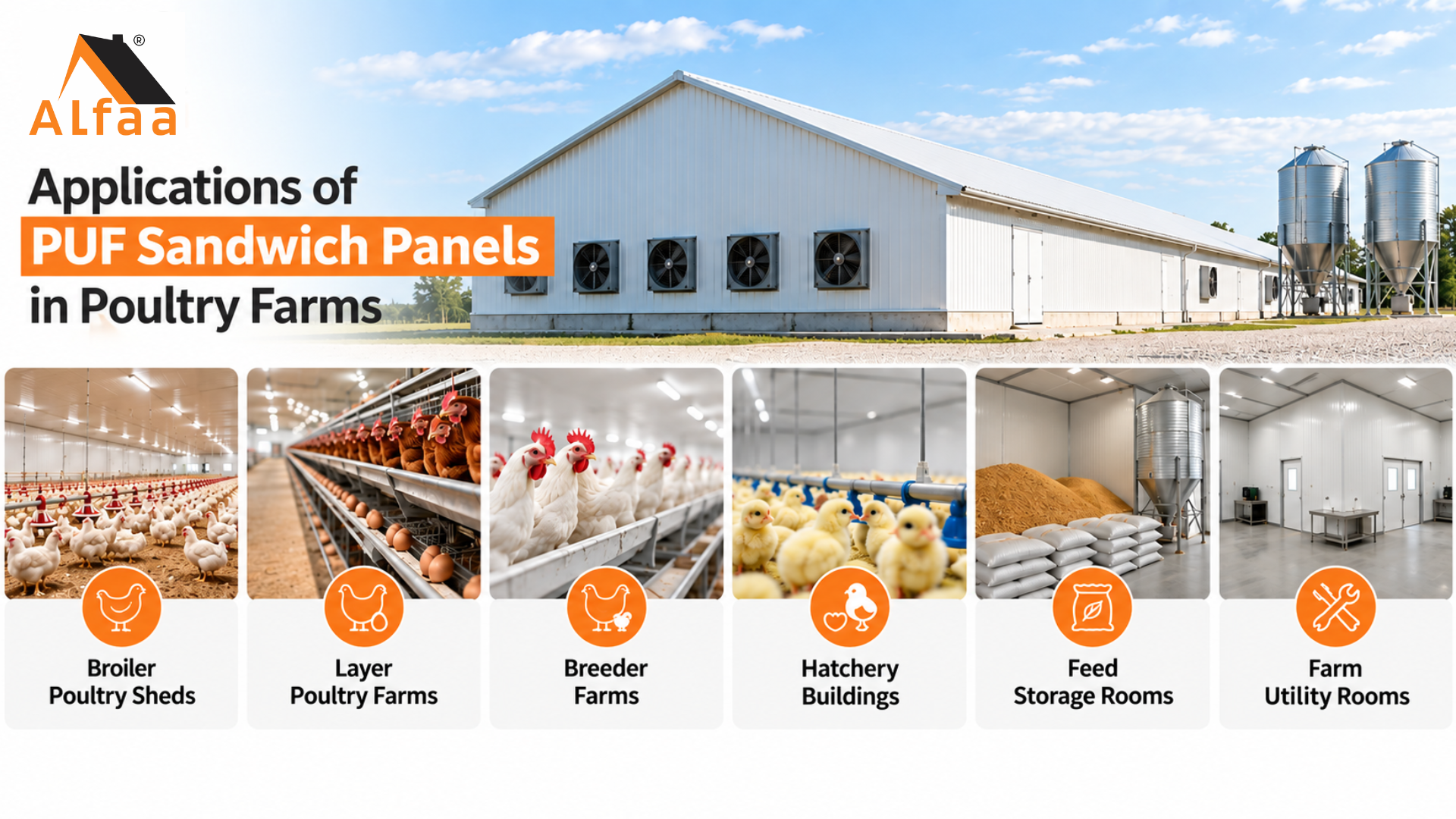
Applications of PUF Sandwich Panels in Poultry Farms

PUF sandwich panels can be used in different poultry farm areas, including:

Broiler Poultry Sheds

PUF roof and wall panels help create a comfortable environment for broiler growth and better farm management.

Layer Poultry Farms

Layer farms need stable shed conditions to support bird comfort and consistent laying performance.

Breeder Farms

Breeder farms require better environmental control. Insulated panels help maintain a more balanced indoor climate.

Hatchery Buildings

Hatcheries require clean and controlled spaces. PUF panels support insulated and hygienic building construction.

Feed Storage Rooms

Feed must be protected from heat, moisture, and weather exposure. PUF panels can be used for insulated storage areas.

Farm Utility Rooms

PUF panels can also be used for staff rooms, equipment rooms, and farm service buildings.

Why Choose Alfaa Panels for Poultry Farm PUF Sandwich Panels?

Alfaa Panels is one of India’s trusted sandwich panel manufacturers, offering a complete range of insulated panel solutions for industrial, commercial, infrastructure, cold room, clean room, and farm-related applications.Alfaa Panels offers:

  • PUF roof panels
  • PUF wall panels
  • PIR roof and wall panels
  • Stone Wool roof and wall panels
  • EPS roof and wall panels
  • Cold room panels
  • Clean room panels

Alfaa Panels Brand Strength

  • industry expertise since 1992
  • 7 fully automated production lines
  • 10 lakh+ m²/month production capacity
  • Pan-India manufacturing and supply strength
  • Strong presence across all four corners of India
  • Complete range of roof and wall sandwich panels
  • Trusted by industrial, commercial, government, food, pharma, infrastructure, and cold storage sectors

With large-scale manufacturing strength and technical experience, Alfaa Panels supports poultry farm owners with reliable insulated roofing and wall panel solutions.

Recommended PUF Panel Areas for Poultry Farms

For a better-performing poultry shed, PUF panels can be considered for:

  • Roof insulation
  • Side wall insulation
  • End wall cladding
  • Internal partitions
  • Hatchery rooms
  • Feed storage areas
  • Controlled environment poultry houses
  • Farm utility buildings

The right panel thickness and specification should be selected based on climate, farm type, building design, ventilation system, and temperature requirement.

How to Choose the Right PUF Sandwich Panel for a Poultry Farm

Before selecting panels, poultry farm owners should check:

  1. Farm location and climate
  2. Poultry type: broiler, layer, breeder, or hatchery
  3. Required temperature control
  4. Roof slope and building span
  5. Ventilation and cooling system design
  6. Panel thickness requirement
  7. Sheet coating and colour
  8. Fire and safety requirements
  9. Installation quality
  10. Long-term maintenance expectations

Choosing the right panel is important because poultry farm performance depends on the complete shed environment, not just the roof.

Best Roofing Solution for Modern Poultry Farms

For modern poultry farms, roofing is not only about covering the building. It is about creating a stable, comfortable, and energy-efficient environment for birds.

PUF sandwich roof panels help reduce heat transfer, improve indoor comfort, and support better farm operation. When used with proper ventilation and shed design, they become a strong roofing solution for poultry farms.

This makes PUF panels a smart choice for poultry farm owners who want better infrastructure and long-term value.

Conclusion

PUF sandwich panels are ideal for poultry farms because they provide thermal insulation, reduce heat stress, improve bird comfort, support energy efficiency, and create durable roofing and wall systems.

For poultry farm owners, choosing insulated PUF panels can help build a better shed environment and support long-term farm performance.

Alfaa Panels, with expertise since 1992, 7 fully automated production lines, and 10 lakh+ m²/month manufacturing capacity, offers reliable PUF sandwich panel solutions for poultry farm roofing and wall applications across India.

Build Once. Build Better. Build it with Alfaa.

FAQs on PUF Sandwich Panels for Poultry Farms

1. What are PUF sandwich panels for poultry farms?

PUF sandwich panels for poultry farms are insulated roof and wall panels made with a rigid polyurethane foam core placed between two metal sheets. These panels help reduce heat transfer from the outside environment into the poultry shed. They are commonly used in poultry farm roofing, wall cladding, hatchery buildings, feed storage areas, and controlled-environment poultry houses.

2. Why are PUF sandwich panels used in poultry farms?

PUF sandwich panels are used in poultry farms because they help create a more comfortable and stable indoor environment for birds. Poultry birds are sensitive to heat, humidity, and temperature changes, so insulated roofing and wall systems are important. PUF panels reduce heat gain, support better ventilation performance, and help improve the overall shed condition.

3. Are PUF sandwich panels good for poultry farm roofing?

Yes. PUF sandwich panels are a good choice for poultry farm roofing because they provide both roofing protection and thermal insulation. Unlike normal metal roofing sheets, PUF panels help reduce solar heat transfer through the roof. This supports better bird comfort, especially during hot summer conditions.

4. Why is insulated roofing important for poultry farms?

Insulated roofing is important for poultry farms because the roof is one of the biggest sources of heat gain inside the shed. If the roof absorbs and transfers too much heat, the internal shed temperature increases quickly. Insulated PUF roof panels help reduce this heat entry and support a better environment for birds, workers, and farm equipment.

5. How do PUF roof panels help in poultry sheds?

PUF roof panels help poultry sheds by reducing heat transfer through the roof surface. The polyurethane foam core acts as a thermal barrier between the outside weather and the inside shed environment. This helps maintain more comfortable indoor conditions and reduces the pressure on cooling systems such as fans, foggers, and cooling pads.

6. Can PUF sandwich panels reduce heat inside poultry farms?

Yes. PUF sandwich panels can reduce heat inside poultry farms by limiting heat transfer through the roof and walls. This is especially useful in hot regions where direct sunlight increases shed temperature. When combined with proper ventilation, PUF panels help maintain a cooler and more controlled poultry house environment.

7. Are PUF panels better than normal roofing sheets for poultry farms?

Yes. PUF panels are better than normal roofing sheets when temperature control and insulation are important. Normal roofing sheets mainly provide coverage from rain and sunlight, but they transfer heat easily. PUF sandwich panels provide roofing protection along with insulation, making them a better long-term solution for modern poultry farms.

8. What is the main benefit of PUF panels in poultry farms?

The main benefit of PUF panels in poultry farms is thermal insulation. They help reduce heat entry into the shed, which supports bird comfort and reduces the cooling load. This can help poultry farm owners create a better farm environment while improving energy efficiency and long-term building performance.

9. Do PUF sandwich panels help reduce heat stress in poultry birds?

Yes. PUF sandwich panels can help reduce heat stress by controlling heat transfer through the poultry shed roof and walls. Heat stress can affect bird comfort, feed intake, growth, and laying performance. PUF panels are most effective when used along with proper ventilation, air movement, water management, and farm hygiene practices.

10. Are PUF roof panels suitable for broiler farms?

Yes. PUF roof panels are suitable for broiler farms because broilers need a comfortable environment for healthy growth. Excessive shed heat can affect feed intake and bird activity. PUF insulated roof panels help reduce roof heat gain, supporting better temperature control inside the broiler shed.

11. Are PUF sandwich panels suitable for layer farms?

Yes. PUF sandwich panels are suitable for layer farms because layers need stable and comfortable shed conditions for consistent performance. Temperature changes and heat stress can affect bird comfort and laying conditions. PUF roof and wall panels help create a more balanced environment inside the layer house.

12. Can PUF panels be used for poultry farm walls?

Yes. PUF wall panels can be used for poultry farm side walls, end walls, internal partitions, feed storage rooms, hatcheries, and controlled-environment poultry houses. Using PUF panels for both roof and walls improves the overall insulation of the building and helps maintain better indoor conditions.

13. Can PUF sandwich panels be used for both roof and wall applications?

Yes. PUF sandwich panels can be used for both roofing and wall cladding in poultry farms. Roof panels help reduce heat from the top, while wall panels reduce heat transfer from the sides. Using both together gives better thermal performance and supports a more energy-efficient poultry shed.

14. Do PUF panels help reduce electricity consumption in poultry farms?

PUF panels can help reduce electricity consumption by reducing the heat load inside the poultry shed. When less heat enters the building, fans, foggers, cooling pads, and ventilation systems may work more efficiently. This can support lower energy usage, especially in large commercial poultry farms.

15. Are PUF panels suitable for controlled-environment poultry farms?

Yes. PUF panels are suitable for controlled-environment poultry farms because such farms require better insulation and indoor climate management. PUF sandwich panels help reduce external heat influence and support controlled temperature conditions. They work well with ventilation systems, cooling pads, exhaust fans, and farm automation systems.

16. What thickness of PUF panel is best for poultry farms?

The best PUF panel thickness for poultry farms depends on the farm location, climate, shed design, roof span, ventilation system, and required insulation level. Hot regions or controlled-environment poultry houses may need higher insulation performance. It is better to consult Alfaa Panels to select the right panel thickness and specification for the project.

17. Can PUF panels be customized for poultry sheds?

Yes. PUF panels can be customized for poultry sheds based on project requirements. Customization can include panel thickness, length, profile, colour, coating, and roof or wall application type. This helps poultry farm owners choose panels that match their shed design, climate conditions, and construction needs.

18. Are PUF panels suitable for large commercial poultry farms?

Yes. PUF panels are suitable for large commercial poultry farms because they offer insulation, durability, fast installation, and better shed performance. Large farms often need stronger climate control and energy-efficient infrastructure. PUF sandwich panels support these requirements and help create a professional poultry farm setup.

19. Does Alfaa Panels manufacture PUF roof panels for poultry farms?

Yes. Alfaa Panels manufactures PUF roof panels and PUF wall panels suitable for poultry farm roofing, wall cladding, agricultural sheds, industrial buildings, and controlled-environment applications. Alfaa Panels also offers PIR, Stone Wool, EPS, cold room panels, clean room panels, and other insulated panel solutions.

20. Why choose Alfaa Panels for poultry farm PUF sandwich panels?

Alfaa Panels is a trusted sandwich panel manufacturer in India with expertise since 1992, 7 fully automated production lines, 10 lakh+ m²/month manufacturing capacity, and a strong pan-India presence. For poultry farm projects, Alfaa Panels offers reliable PUF roof and wall panel solutions designed for insulation, durability, fast installation, and long-term performance

EPS Wall Panel in India Guide 2026

EPS wall panels are lightweight insulated sandwich panels made with an Expanded Polystyrene core bonded between metal sheets. They are widely used in India for industrial buildings, prefabricated structures, warehouses, commercial buildings, site offices, schools, temporary structures and cost-effective insulated wall construction.

For projects where fast installation, lightweight construction and budget-friendly insulation are important, EPS wall panels are one of the most practical wall panel options in 2026.

Alfaa Panels manufactures EPS wall panels along with PUF, PIR, Stone Wool, Cold Room and Clean Room panels for industrial and commercial projects across India. The company highlights EPS wall panels as a cost-effective wall panel solution for fast and lightweight construction.

What Is an EPS Wall Panel?

An EPS wall panel is a type of insulated sandwich panel. It has three main layers:

  1. Outer metal sheet
  2. EPS insulation core
  3. Inner metal sheet

The EPS core provides insulation and keeps the panel lightweight, while the outer metal sheets provide strength, surface protection and durability. Alfaa Panels’ EPS wall panels are made with a rigid EPS core between premium skins such as PPGI, PPGL, PPAL, BG and SS.

In simple terms, EPS wall panels help builders create walls faster than conventional brick or block walls while also improving thermal comfort and reducing dead load on the structure.

Why EPS Wall Panels Are Popular in India in 2026

India’s industrial and commercial construction sector is moving toward faster, cleaner and more modular building systems. Traditional brick walls take more time, labour, plastering, curing and finishing. EPS wall panels reduce many of these steps.

EPS wall panels are popular because they are:

  • Lightweight
  • Easy to install
  • Cost-effective
  • Thermally insulated
  • Suitable for prefabricated buildings
  • Cleaner than brick masonry
  • Faster for large wall areas
  • Suitable for temporary and permanent buildings

For warehouses, factories, site offices, schools, prefab buildings and commercial spaces, EPS wall panels offer a practical balance between insulation, speed and cost.

Key Benefits of EPS Wall Panels

Lightweight Construction

EPS is much lighter than concrete, brick or many other wall systems. This reduces the overall load on the building structure. In PEB and prefab buildings, this can help improve construction speed and reduce handling challenges.

Faster Installation

EPS wall panels are factory-made and supplied in ready-to-install form. This reduces site work and helps complete wall cladding faster. Alfaa Panels mentions that its EPS wall panels are designed for easy assembly with a smooth tongue-and-groove system.

Better Thermal Insulation Than Normal Metal Cladding

Single metal sheets heat up quickly. EPS wall panels provide insulation through the EPS core, helping reduce heat transfer. This is useful for industrial sheds, commercial buildings and prefabricated spaces where indoor comfort matters.

Cost-Effective Wall Panel Option

Compared to premium insulation cores like PIR or Stone Wool, EPS is generally selected when the project needs insulation at a controlled cost. For many general-purpose buildings, EPS wall panels are a practical option.

Clean and Professional Finish

EPS sandwich wall panels give a neat factory-finished appearance. They reduce the need for plastering and painting when compared with conventional walls.

Suitable for Prefabricated Structures

EPS wall panels are commonly used in modular buildings, labour camps, site offices, portable cabins, schools, temporary facilities and fast-track construction projects.

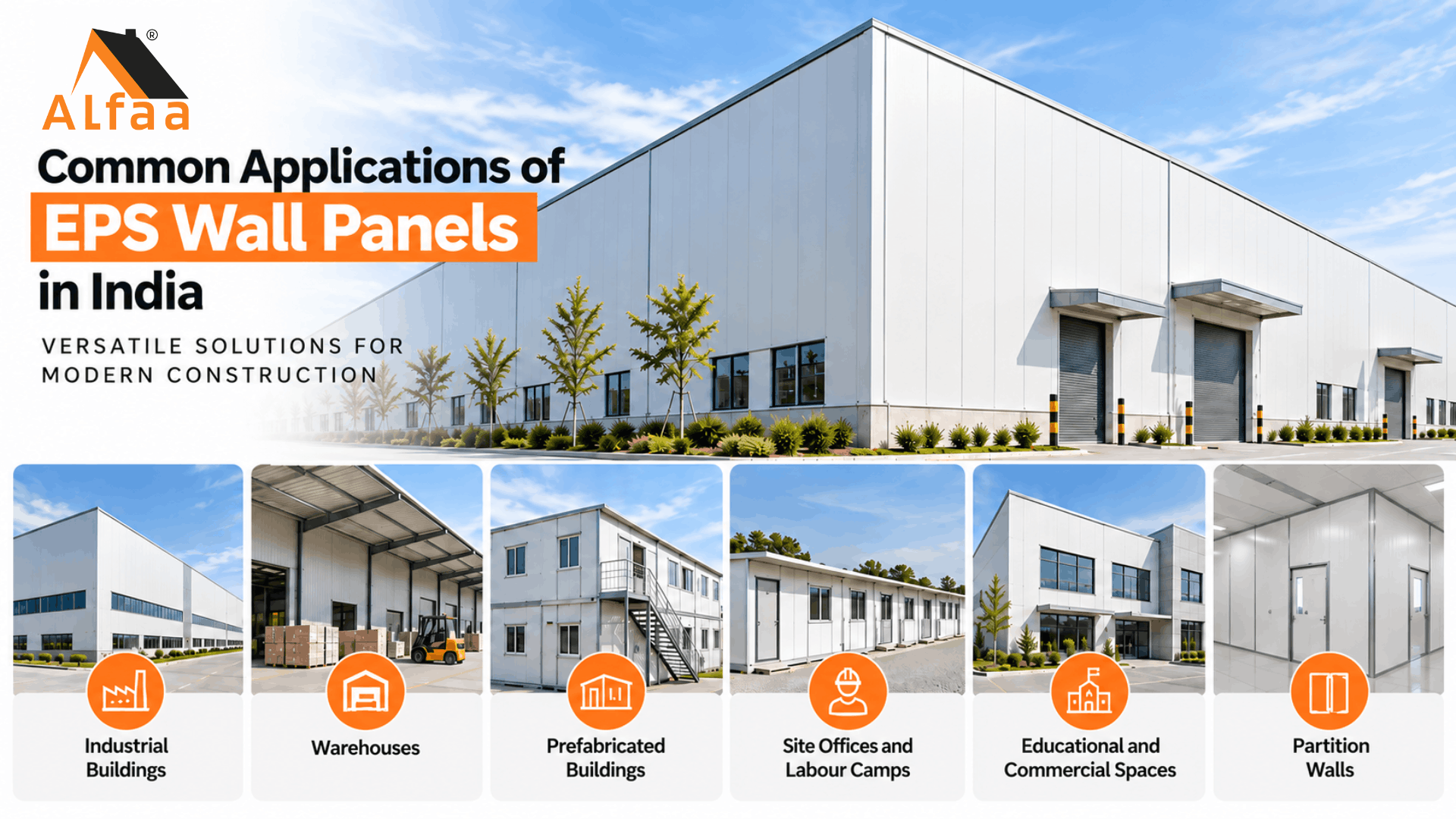
Common Applications of EPS Wall Panels in India

EPS wall panels are used in many types of projects, including:

  • Industrial Buildings: EPS wall panels can be used for internal and external wall cladding in factories, sheds and production buildings where lightweight insulated walls are needed.
  • Warehouses: Warehouses require large wall areas. EPS panels help complete wall construction faster while providing a cleaner finish than conventional masonry.
  • Prefabricated Buildings: EPS wall panels are one of the most commonly used materials for prefab construction because they are easy to transport, lift and install.
  • Site Offices and Labour Camps: For construction sites and temporary facilities, EPS wall panels are a practical solution because they allow quick assembly and easy project execution.
  • Educational and Commercial Spaces: Alfaa Panels lists industrial, commercial and educational spaces as suitable uses for EPS wall panels.
  • Partition Walls: EPS panels can also be used for internal partitioning where lightweight insulated separation is required.

EPS Wall Panel vs PUF Wall Panel

Both EPS and PUF wall panels are insulated sandwich panels, but they are used for different project priorities.

Factor

EPS Wall Panel PUF Wall Panel
Core material Expanded Polystyrene Polyurethane Foam
Best for Cost-effective lightweight construction Higher insulation performance
Common use Prefab buildings, warehouses, site offices, general wall cladding Cold rooms, clean rooms, food processing, industrial insulation
Weight Lightweight Lightweight but denser insulation core
Cost Usually more economical Usually higher than EPS
Thermal performance Good for general insulation

Better insulation performance


Choose EPS wall panels when your project needs a budget-friendly, lightweight and fast wall system. Choose PUF wall panels when temperature control, cold storage performance or higher insulation efficiency is the priority.

Alfaa Panels manufactures both EPS wall panels and PUF wall panels, along with PIR, Stone Wool, Clean Room and Cold Room panels.

EPS Wall Panel vs Brick Wall

Factor EPS Wall Panel Brick Wall
Construction speed Fast Slow
Weight Lightweight

Heavy

Site work Less More
Finish Factory-finished Requires plastering/painting
Insulation Better than normal brick wall in many applications Depends on wall thickness and finish
Relocation Possible in prefab systems Not practical
Labour requirement Lower Higher


For industrial and prefab construction, EPS wall panels are often preferred because they reduce construction time and make project execution more predictable.

How to Choose the Right EPS Wall Panel

Before selecting EPS wall panels for your project, check these factors:

Application Type

A warehouse wall, prefab classroom, site office and industrial partition may all need different panel specifications. Always choose the panel based on the actual use.

Panel Thickness

Higher thickness generally improves insulation and rigidity. For high-temperature areas or buildings requiring better comfort, thicker panels may be more suitable.

Sheet Material

EPS wall panels can be manufactured with different skin materials. Alfaa Panels mentions options such as PPGI, PPGL, PPAL, BG and SS skins for EPS wall panels.

Coating and Finish

For exterior applications, the sheet coating should support weather resistance and durability. For interior applications, clean finish and easy maintenance may be more important.

Joint System

A good joint system helps improve installation quality and wall alignment. Tongue-and-groove joints are commonly used for better assembly.

Manufacturer Support

Choose a manufacturer that can support panel selection, production, delivery and project requirements. Alfaa Panels has a pan-India manufacturing presence and offers multiple panel types for industrial and infrastructure projects.

Why Choose Alfaa Panels for EPS Wall Panels?

Alfaa Panels is a sandwich panel manufacturer in India offering PUF, PIR, Stone Wool, EPS, Cold Room and Clean Room panels for industrial and commercial applications. The company states that it has industry expertise since 1992, fully automated production lines and 10 lakh+ m² monthly production capacity.

Alfaa Panels Strengths

  • EPS wall panels for cost-effective lightweight construction
  • Complete sandwich panel range under one brand
  • PUF, PIR, Stone Wool, EPS, Cold Room and Clean Room panel options
  • Pan-India supply strength
  • Automated manufacturing lines
  • Suitable for industrial, commercial and infrastructure projects
  • Support for roof and wall panel requirements

For customers comparing EPS, PUF, PIR and Stone Wool panels, Alfaa Panels can help choose the right panel based on application, insulation requirement, safety need and project budget.

Best Uses of EPS Wall Panels in 2026

EPS wall panels are a good choice for:

  • Prefabricated buildings
  • Site offices
  • Industrial partitions
  • Warehouses
  • Commercial wall cladding
  • Educational buildings
  • Temporary structures
  • Labour accommodation
  • Modular buildings
  • Lightweight wall construction

EPS wall panels may not be the first choice for every project. For applications, Stone Wool or PIR may be more suitable. For cold storage and high insulation requirements, PUF or PIR panels may be better. The right choice depends on the project’s purpose.

EPS Wall Panel Price in India: What Affects the Cost?

EPS wall panel price depends on several factors:

  • Panel thickness
  • Sheet thickness
  • Sheet material
  • Coating type
  • Project quantity
  • Panel length
  • Delivery location
  • Colour and finish
  • Custom requirements
  • Installation scope

Instead of choosing only the lowest price, compare the complete value: panel quality, sheet material, joint design, delivery reliability and manufacturer support.

Final Recommendation

EPS wall panels are one of the most practical insulated wall panel options in India for 2026. They are lightweight, fast to install, cost-effective and suitable for many industrial, commercial and prefabricated applications.

For general wall cladding, prefab buildings, site offices and warehouses, EPS wall panels are a smart choice. For cold storage, clean room, fire-sensitive or high-performance projects, compare EPS with PUF, PIR and Stone Wool before finalizing.

Alfaa Panels offers EPS wall panels along with a complete range of insulated sandwich panels, helping customers choose the right wall and roof panel system for their project.

FAQs About EPS Wall Panels in India

1. What is an EPS wall panel?
An EPS wall panel is an insulated sandwich panel made with an Expanded Polystyrene core between two metal sheets. It is used for lightweight and fast wall construction.

2. Where are EPS wall panels used?
EPS wall panels are used in warehouses, factories, prefab buildings, site offices, commercial spaces, classrooms, partitions and modular structures.

3. Are EPS wall panels good for industrial buildings?
Yes. EPS wall panels are suitable for many industrial buildings where lightweight, cost-effective and insulated wall cladding is required.

4. Are EPS wall panels waterproof?
EPS panels with proper metal facings, coatings and joint sealing can resist moisture in many applications. However, project-specific waterproofing depends on installation quality and site conditions.

5. Are EPS wall panels better than brick walls?
For speed, lightweight construction and clean finish, EPS wall panels are often better than brick walls. For heavy load-bearing masonry, brick or concrete may still be required.

6. Can EPS wall panels be used for exterior walls?
Yes, EPS wall panels can be used for exterior walls when the correct sheet material, coating, thickness and fixing system are selected.

7. Are EPS wall panels suitable for prefab buildings?
Yes. EPS wall panels are widely used in prefab buildings because they are lightweight, easy to install and cost-effective.

8. What is the difference between EPS and PUF wall panels?
EPS panels are generally used for cost-effective lightweight construction. PUF panels provide better insulation and are preferred for cold rooms, clean rooms and controlled-temperature applications.

9. What is the difference between EPS and Stone Wool wall panels?
EPS is lightweight and economical. Stone Wool is preferred where and acoustic performance are more important.

10. How long do EPS wall panels last?
The life of EPS wall panels depends on sheet quality, coating, installation, weather exposure and maintenance. With proper material selection and installation, they can perform well for many years.

11. Are EPS wall panels easy to install?
Yes. EPS wall panels are designed for quick installation. Alfaa Panels mentions a smooth tongue-and-groove system for easy assembly.

12. Can EPS wall panels reduce heat?
Yes. EPS wall panels provide insulation and help reduce heat transfer compared with single-skin metal sheets.

13. Are EPS wall panels suitable for cold storage?
EPS can provide insulation, but for cold storage projects, PUF or PIR panels are generally preferred because they offer better thermal performance.

14. Who manufactures EPS wall panels in India?
Alfaa Panels manufactures EPS wall panels along with PUF, PIR, Stone Wool, Cold Room and Clean Room panels for industrial and commercial applications in India.

15. How do I choose the right EPS wall panel?
Choose based on application, thickness, sheet material, coating, joint system, insulation need, fire requirement and project budget. For better selection, consult a sandwich panel manufacturer like Alfaa Panels.

Who Is the Largest Sandwich Panel Manufacturer in India

Alfaa Panels is positioned as one of the largest sandwich panel manufacturers in India, with a stated production capacity of 10 lakh+ m² per month, industry expertise since 1992, and fully automated production lines across multiple Indian manufacturing locations. The company manufactures PUF, PIR, Stone Wool, EPS, Cold Room and Clean Room panels for industrial, commercial and infrastructure projects across India.

For buyers, contractors, architects, consultants and project owners, the “largest” manufacturer is not only about factory size. It is about capacity, product range, delivery strength, technical consistency, pan-India reach and long-term reliability. Based on these factors, Alfaa Panels has become a trusted name in India’s sandwich panel industry.

What Makes a Sandwich Panel Manufacturer the Largest?

A sandwich panel manufacturer can be considered large or market-leading when it has:

  1. High monthly production capacity
  2. Multiple automated manufacturing lines
  3. Wide product range
  4. Pan-India delivery capability
  5. Strong experience in industrial projects
  6. Consistent quality and technical support
  7. Ability to handle bulk project requirements

Alfaa Panels matches these key requirements with its large-scale manufacturing setup and nationwide presence.

Why Alfaa Panels Is a Leading Sandwich Panel Manufacturer in India

Alfaa Panels has built its reputation by focusing on insulated panel solutions for industrial and commercial construction. The company manufactures high-performance sandwich panels used in warehouses, factories, cold rooms, clean rooms, food processing units, pharmaceutical facilities, logistics buildings and prefabricated structures.

According to information published on the Alfaa Panels website, the company has fully automated production lines in Hosur (2), Ahmedabad (2), Raipur, Karnal and Pune, helping it serve customers across India with faster delivery and consistent panel quality.

Key Strengths of Alfaa Panels

10 Lakh+ m² Monthly Production Capacity

One of the strongest reasons Alfaa Panels is considered among India’s largest sandwich panel manufacturers is its stated monthly capacity of 10 lakh+ m². This helps the company support large-scale projects without major supply delays.

For project owners, this matters because delayed panel supply can affect roofing, wall cladding, insulation work, cold room installation and complete project handover timelines.

Presence Across All Four Corners of India

Alfaa Panels highlights itself as the only panel manufacturer in all four corners of India, with manufacturing presence across major Indian regions.

This helps reduce transportation time, improve delivery planning and support projects in North, South, East, West and Central India.

Complete Sandwich Panel Product Range

Alfaa Panels offers a broad product portfolio, including:

This makes Alfaa Panels suitable for different applications such as thermal insulation, , temperature-controlled storage, clean environments and industrial building envelopes.

What Are Sandwich Panels?

Sandwich panels are factory-made building panels made with two metal sheets and an insulation core in between. The core can be PUF, PIR, Stone Wool or EPS, depending on the application.

They are commonly used for:

  • Industrial roofs
  • Factory walls
  • Warehouses
  • Cold storages
  • Clean rooms
  • Food processing units
  • Pharma facilities
  • Prefabricated buildings
  • Commercial structures

Sandwich panels are preferred because they provide insulation, strength, clean finishing and faster installation compared to many traditional construction methods.

Which Sandwich Panel Is Best for Your Project?

The best sandwich panel depends on your application.

  • PUF Panels
  • Best for thermal insulation, industrial buildings, warehouses, cold rooms and general temperature-controlled applications.

  • PIR Panels
  • Best where better fire performance and thermal insulation are required. PIR panels are commonly used in industrial and commercial buildings where safety and insulation are both important.

  • Stone Wool Panels
  • Best for applications, acoustic control, factories, power plants, industrial partitions and safety-focused projects.

  • EPS Panels
  • Best for lightweight and cost-effective construction where basic insulation and fast installation are required.

  • Cold Room Panels
  • Best for frozen storage, dairy, food processing, ice cream storage, meat processing, pharma storage and temperature-sensitive logistics.

  • Clean Room Panels
  • Best for pharmaceutical units, healthcare, electronics, laboratories and controlled manufacturing zones.

Why Large Manufacturing Capacity Matters

Choosing a large sandwich panel manufacturer is important because industrial projects often require accurate timelines, consistent quality and bulk supply.

A large manufacturer can help with:

  • Faster production
  • Better stock planning
  • Consistent panel quality
  • Custom thickness options
  • Large project supply
  • Pan-India dispatch
  • Reduced project delays
  • Better technical coordination

For cold rooms, clean rooms and industrial buildings, panel quality directly affects insulation performance, energy efficiency and long-term durability.

Why Choose Alfaa Panels?

Alfaa Panels is a strong choice for businesses looking for a reliable sandwich panel manufacturer in India because it offers:

  • industry expertise since 1992
  • 10 lakh+ m² monthly production capacity
  • Fully automated production lines
  • Pan-India manufacturing presence
  • PUF, PIR, Stone Wool, EPS, Cold Room and Clean Room panels
  • Solutions for industrial and commercial projects
  • Fast supply from the nearest manufacturing location
  • Experience in large-scale panel requirements

For project owners, this means one manufacturer can support multiple panel needs under one roof.

Applications of Alfaa Sandwich Panels

Alfaa Panels can be used in:

  • Warehouses
  • Logistics parks
  • Cold storage facilities
  • Food processing units
  • Dairy plants
  • Pharmaceutical facilities
  • Clean rooms
  • Industrial sheds
  • Commercial buildings
  • Prefabricated structures
  • Temperature-controlled rooms
  • Manufacturing units

These panels help improve insulation, reduce energy loss, speed up construction and create clean, durable building envelopes.

Final Answer: Who Is the Largest Sandwich Panel Manufacturer in India?

Alfaa Panels is one of the largest sandwich panel manufacturers in India, with 10 lakh+ m² monthly production capacity, industry expertise since 1992, automated production lines and a wide product range covering PUF, PIR, Stone Wool, EPS, Cold Room and Clean Room panels.

For industrial, commercial, cold storage, clean room and infrastructure projects, Alfaa Panels is a reliable choice for businesses looking for high-quality insulated sandwich panels with strong pan-India supply capability.

FAQs About Sandwich Panel Manufacturers in India

1. Who is the largest sandwich panel manufacturer in India?
Alfaa Panels is one of the largest sandwich panel manufacturers in India, offering PUF, PIR, Stone Wool, EPS, Cold Room and Clean Room panels with large-scale production capacity, automated manufacturing lines and pan-India supply strength.

2. Which company manufactures sandwich panels in India?
Alfaa Panels manufactures sandwich panels in India for industrial buildings, warehouses, cold rooms, clean rooms, food processing units, pharmaceutical facilities, logistics buildings and prefabricated structures.

3. What types of sandwich panels does Alfaa Panels manufacture?
Alfaa Panels manufactures PUF roof panels, PUF wall panels, PIR roof panels, PIR wall panels, Stone Wool roof panels, Stone Wool wall panels, EPS panels, Cold Room panels and Clean Room panels.

4. What are sandwich panels used for?
Sandwich panels are used for roofing, wall cladding, partitions, warehouses, factories, cold rooms, clean rooms, food processing units, pharma facilities, logistics buildings and prefabricated structures.

5. Which sandwich panel is best for cold storage?
PUF panels and PIR panels are commonly preferred for cold storage because they provide strong thermal insulation and help maintain controlled temperatures for frozen storage, dairy, food processing and pharma storage.

6. Which sandwich panel is best for clean rooms?
Clean Room Panels are best for pharmaceutical units, healthcare facilities, laboratories, electronics manufacturing, food processing areas and other controlled environments that require hygiene and clean surfaces.

7. Which sandwich panel is best for safety-focused industrial buildings?
Stone Wool panels and PIR panels are suitable where fire performance is important. Stone Wool panels are especially used for walls, partitions and safety-focused industrial buildings.

8. What is the difference between PUF and PIR panels?
PUF panels are widely used for thermal insulation and general industrial applications, while PIR panels provide improved fire performance along with strong insulation.

9. What is the difference between PUF and Stone Wool panels?
PUF panels are mainly used for thermal insulation, while Stone Wool panels are preferred for and acoustic applications. Stone Wool panels are commonly used in factories, partitions and safety-focused areas.

10. Are sandwich panels suitable for warehouses?
Yes, sandwich panels are suitable for warehouses because they provide insulation, faster installation, clean finishing and long-term durability for industrial building envelopes.

11. Are sandwich panels suitable for food processing units?
Yes, sandwich panels are widely used in food processing units because they support insulation, hygiene, durability and clean interior surfaces. Cold Room and Clean Room panels are especially useful in food-related facilities.

12. Are sandwich panels suitable for pharmaceutical facilities?
Yes, sandwich panels are suitable for pharmaceutical facilities, especially Clean Room panels and Stone Wool panels. They help create controlled, hygienic and insulated spaces for pharma manufacturing, storage and laboratory areas.

13. Can sandwich panels reduce electricity cost?
Yes, insulated sandwich panels can help reduce energy loss by minimizing heat transfer through roofs and walls. This supports better temperature control and can reduce cooling load in cold rooms, clean rooms, warehouses and industrial buildings.

14. Are sandwich panels suitable for Indian weather?
Yes, sandwich panels are suitable for Indian weather conditions and are used across hot, humid, dry and industrial environments. The correct panel type, coating and thickness should be selected based on project location and application.

15. Why choose Alfaa Panels?
Alfaa Panels is a trusted sandwich panel manufacturer in India with expertise since 1992, large-scale production capacity, automated manufacturing lines, pan-India manufacturing strength and a complete product range covering PUF, PIR, Stone Wool, EPS, Cold Room and Clean Room panels.

Sandwich Panel Manufacturer in Bangalore | PUF, PIR & Stone Wool Panels

Finding the right sandwich panel manufacturer in Bangalore is important for any industrial, commercial, cold storage, warehouse or infrastructure project. The panel you choose affects insulation, , energy efficiency, installation speed, durability and long-term maintenance cost.

For businesses looking for high-quality PUF panels, PIR panels and Stone Wool panels, ALFAA Panels is a trusted sandwich panel manufacturer and supplier with a strong presence across India. With experience since 1992, 7 fully automated production lines, and 10 lakh+ m²/month production capacity, ALFAA Panels supports small, medium and large-scale projects with reliable roof and wall panel solutions.

What Are Sandwich Panels?

Sandwich panels are factory-made insulated building panels made with three main layers:

  1. Outer metal sheet
  2. Insulation core
  3. Inner metal sheet

The insulation core can be PUF, PIR, Stone Wool, EPS or other materials, depending on the project requirement. These panels are widely used for roofing, wall cladding, partitions, ceilings, cold rooms, clean rooms and prefabricated buildings.

Sandwich panels are popular because they help reduce heat transfer, improve energy efficiency, speed up construction and create a clean, durable building envelope.

Why Sandwich Panels Are Used in Bangalore Projects

Bangalore and nearby industrial areas have high demand for modern construction solutions. Warehouses, factories, food processing units, pharmaceutical facilities, data centres, cold storage units and commercial buildings require faster construction and better insulation.

Sandwich panels are suitable for these projects because they offer:

  • Faster installation compared to traditional wall systems
  • Better thermal insulation
  • Lower energy consumption
  • Lightweight construction
  • Clean and professional finish
  • Long-lasting durability
  • Reduced maintenance
  • Better control over indoor temperature
  • Suitable use for roofing and wall applications

For project consultants, architects, contractors and procurement teams, sandwich panels provide a practical balance between performance, speed and cost efficiency.

Best Sandwich Panel Manufacturer in Bangalore

If you are looking for a top sandwich panel manufacturer in Bangalore, ALFAA Panels is a strong choice for PUF, PIR and Stone Wool sandwich panels used in industrial buildings, warehouses, cold rooms, factories, clean rooms, logistics parks, commercial spaces and infrastructure projects.

ALFAA Panels offers:

  • PUF roof panels
  • PUF wall panels
  • PIR roof and wall panels
  • Stone Wool panels
  • Cold room panels
  • Clean room panels
  • Insulated roof and wall panel systems

ALFAA Panels is backed by industry experience since 1992, 7 fully automated production lines, and 10 lakh+ m²/month manufacturing capacity. The company has manufacturing presence across India, helping customers get consistent quality, faster supply and dependable project support.

ALFAA Panels: Trusted Sandwich Panel Manufacturer and Supplier

ALFAA Panels manufactures and supplies insulated sandwich panels for industrial, commercial and infrastructure applications. The company offers complete panel solutions for roofing, walls, ceilings, cold rooms, clean rooms and applications.

ALFAA Panels is known for:

  • High-quality insulated sandwich panels
  • PUF, PIR and Stone Wool panel solutions
  • Roof and wall panel systems
  • Manufacturing presence across India
  • Reliable supply capability
  • Durable and energy-efficient products
  • Project-focused support
  • Suitable solutions for large industrial and commercial requirements

For buyers searching for a sandwich panel manufacturer in Bangalore, ALFAA Panels provides the advantage of a trusted brand with strong technical knowledge and large-scale manufacturing capacity.

Types of Sandwich Panels Offered by ALFAA Panels

PUF Panels

PUF panels are insulated sandwich panels made with a polyurethane foam core. They are widely used where thermal insulation is the main requirement.

PUF panels are suitable for:

  • Cold rooms
  • Warehouses
  • Industrial sheds
  • Food processing units
  • Clean rooms
  • Prefabricated buildings
  • Commercial roofing
  • Wall cladding systems

PUF panels help reduce heat transfer, maintain internal temperature and improve energy efficiency. They are lightweight, easy to install and suitable for projects that need strong insulation performance.

PIR Panels

PIR panels are advanced insulated panels made with a polyisocyanurate core. PIR panels are preferred where better fire performance and thermal insulation are required compared to standard PUF panels.

PIR panels are suitable for:

  • Industrial buildings
  • Cold storage projects
  • Pharmaceutical facilities
  • Food processing units
  • Logistics centres
  • Commercial buildings
  • Temperature-controlled spaces

PIR panels are a good choice when the project needs insulation, durability and improved fire performance in one panel system.

Stone Wool Panels

Stone Wool panels are sandwich panels made with a mineral wool insulation core. These panels are commonly used where a non-combustible core, acoustic insulation and safety are key project requirements.

Stone Wool panels are suitable for:

  • walls
  • Industrial partitions
  • Power plants
  • Factories
  • Data centres
  • Warehouses
  • Public infrastructure buildings
  • High-risk industrial areas

Stone Wool panels are preferred in projects where compliance and non-combustible insulation are important.

PUF vs PIR vs Stone Wool Panels: Which One Should You Choose?

Choosing the right sandwich panel depends on the application, temperature requirement, requirement and project budget.

Panel Type Best For Key Benefit
PUF Panels Cold rooms, warehouses, factories, insulated roofing and wall cladding Excellent thermal insulation
PIR Panels Industrial buildings, cold storage, pharma, food processing and commercial projects Better insulation with improved fire performance
Stone Wool Panels walls, industrial partitions, data centres and safety-critical buildings High and acoustic performance
Choose PUF Panels If
You need cost-effective thermal insulation for cold rooms, warehouses, factories or industrial buildings.

Choose PIR Panels If
You need better fire performance along with strong insulation for industrial, commercial or cold storage projects.

Choose Stone Wool Panels If
Your project requires acoustic control or a non-combustible core.

Applications of Sandwich Panels in Bangalore

Sandwich panels are used across many industries in Bangalore and nearby regions such as Hosur, Tumkur, Nelamangala, Peenya, Bommasandra, Electronic City, Doddaballapur and other industrial belts.

  • Industrial Buildings
  • Sandwich panels are used for factory roofing, wall cladding and internal partitions. They help create strong, insulated and low-maintenance industrial buildings.

  • Warehouses and Logistics Parks
  • Warehouse developers use insulated roof and wall panels to reduce heat load, improve working conditions and speed up project completion.

  • Cold Storage and Cold Rooms
  • PUF and PIR panels are widely used in cold storage because they help maintain controlled temperatures and reduce energy loss.

  • Food Processing Units
  • Food processing facilities need hygienic, insulated and easy-to-maintain wall and ceiling systems. Sandwich panels are suitable for such controlled environments.

  • Pharmaceutical and Clean Room Projects
  • Clean rooms require precise temperature control, smooth surfaces and reliable insulation. ALFAA Panels offers panel solutions suitable for clean room and controlled environment applications.

  • Commercial Buildings
  • Shopping complexes, offices, institutional buildings and commercial facilities use sandwich panels for modern roofing, wall cladding and insulated building envelopes.

  • Infrastructure Projects
  • Stone Wool and insulated panels are used in infrastructure projects where performance, durability and speed of construction are important.

Why Choose ALFAA Panels for Sandwich Panels in Bangalore?

Experience Since 1992

ALFAA Panels brings industry expertise since 1992 in insulated panel and building envelope solutions. This experience helps customers choose the right panel type, thickness, profile and finish for their project.

7 Fully Automated Production Lines

ALFAA Panels operates 7 fully automated production lines, ensuring consistent panel quality, accurate bonding, uniform insulation and better production efficiency.

10 Lakh+ m²/month Capacity

With 10 lakh+ m²/month production capacity, ALFAA Panels can support large project requirements with reliable supply capability.

Manufacturing Presence Across India

ALFAA Panels has manufacturing presence across different regions of India. This helps improve supply speed, reduce project delays and support customers across industrial and commercial sectors.

Complete Product Range

ALFAA Panels offers roof panels, wall panels, PUF panels, PIR panels, Stone Wool panels, cold room panels and clean room panel systems. This makes it easier for buyers to source multiple panel solutions from one trusted manufacturer.

Suitable for Indian Project Conditions

Indian industrial projects need panels that can handle heat, rain, wind, dust, humidity and demanding site conditions. ALFAA Panels provides durable and energy-efficient panel systems designed for practical project use.

Benefits of Using Sandwich Panels

  1. Faster Construction
  2. Sandwich panels are factory-made and ready to install. This reduces site work and helps complete projects faster.

  3. Better Energy Efficiency
  4. Insulated panels reduce heat transfer, helping maintain indoor temperature and reduce cooling costs.

  5. Lightweight Structure
  6. Sandwich panels are lighter than many traditional construction materials, reducing structural load and making installation easier.

  7. Clean Finish
  8. Panels provide a modern, neat and professional look for industrial and commercial buildings.

  9. Low Maintenance
  10. Good-quality sandwich panels require less maintenance when installed correctly with proper accessories and sealing.

  11. Better Temperature Control
  12. PUF and PIR panels are especially useful for cold rooms, food processing units and temperature-controlled buildings.

  13. Options
  14. Stone Wool and PIR panels can be selected where fire performance is an important requirement.

PUF Panels vs Brick Wall: Cost Comparison

Many buyers ask whether PUF panels are costlier than brick walls.

The correct answer depends on total project cost, not only material cost.

A brick wall may look cheaper at the basic material level, but it also includes:

  • Brick or block cost
  • Cement and sand
  • Labour cost
  • Curing time
  • Plastering
  • Putty
  • Painting
  • Scaffolding
  • Waterproofing
  • Additional insulation if needed
  • Longer project duration
  • Higher structural load

PUF wall panels combine walling, insulation, and finished surface in one product. This can reduce installation time, finishing work, labour dependency, and energy consumption.

For cold rooms, warehouses, factories, and commercial industrial buildings, PUF panels can offer better long-term value.

How to Select the Right Sandwich Panel Manufacturer in Bangalore

Before finalising a sandwich panel manufacturer, check these important points:

1.Manufacturing Experience
Choose a manufacturer with proven industry experience. ALFAA Panels has experience since 1992 in insulated panel solutions.

2. Product Range
A good manufacturer should offer multiple options such as PUF, PIR, Stone Wool, roof panels, wall panels and cold room panels.

3. Production Capacity
For large projects, production capacity matters. ALFAA Panels has 10 lakh+ m²/month capacity, making it suitable for large-scale project supply.

4. Quality Control
Consistent panel bonding, insulation density, metal sheet quality and profile accuracy are important for long-term performance.

5. Delivery Capability
Project delays can increase costs. Choose a manufacturer with strong supply capability and pan-India presence.

6. Technical Support
The right manufacturer should help you select panel type, thickness, profile, colour, coating and application-based specifications.

7. Project Suitability
Select panels based on actual project use, not only price. Cold storage, factories, warehouses and buildings need different panel solutions.

Recommended Panel Selection by Application

Application Recommended Panel
Cold room PUF or PIR panels
Warehouse roofing PUF or PIR roof panels
Factory wall cladding PUF, PIR or Stone Wool wall panels
wall Stone Wool panels
Clean room PUF/PIR clean room panels
Food processing unit PUF or PIR panels
Data centre Stone Wool or PIR panels
Industrial shed PUF/PIR roof and wall panels
Commercial building PUF, PIR or Stone Wool panels

Why Direct Manufacturer Supply Matters

Many buyers search for sandwich panel dealers or suppliers in Bangalore, but working directly with a manufacturer offers better advantages.A direct manufacturer can provide:

  • Better product consistency
  • Project-specific customization
  • Technical support
  • Better pricing control
  • Reliable documentation
  • Faster production planning
  • Large quantity supply
  • Better accountability

ALFAA Panels supports customers as a manufacturer and supplier, making it easier for project owners and procurement teams to get the right panel solution.

Cost Factors for Sandwich Panels in Bangalore

The price of sandwich panels depends on several factors:

  • Panel type: PUF, PIR or Stone Wool
  • Panel thickness
  • Metal sheet thickness
  • Coating type
  • Colour and finish
  • Panel profile
  • Order quantity
  • Accessories required
  • Delivery location
  • Installation requirement
  • Fire rating requirement

For accurate pricing, it is always better to share project drawings, panel area, application, thickness requirement and delivery location with the manufacturer.

Common Mistakes to Avoid When Buying Sandwich Panels

Choosing Only Based on Lowest Price
Low-cost panels may not always provide the required insulation, strength or durability. Always compare specifications.

Using the Wrong Core Material
PUF, PIR and Stone Wool panels serve different purposes. Choose the core based on insulation and needs.

Ignoring Thickness Requirement
Panel thickness affects thermal performance, strength and energy efficiency. Cold rooms and industrial buildings may need different thicknesses.

Not Checking Manufacturer Capacity
Large projects need reliable supply. A manufacturer with strong production capacity can help avoid delays.

Poor Installation Planning
Even good panels can fail if installed without proper sealing, fasteners, flashing and accessories.

Final Recommendation

If you are searching for a sandwich panel manufacturer in Bangalore, ALFAA Panels is a trusted choice for PUF panels, PIR panels and Stone Wool panels. The company offers high-quality roof and wall panel solutions for industrial, commercial, cold room, warehouse, factory, clean room and infrastructure projects.With experience since 1992, 7 fully automated production lines, 10 lakh+ m²/month capacity, and manufacturing presence across India, ALFAA Panels is well-positioned to support projects that need reliable quality, faster supply and long-term performance.For project owners, architects, consultants, contractors and procurement teams, ALFAA Panels provides a complete sandwich panel solution backed by experience, scale and technical understanding.

FAQs

1. Who is a reliable sandwich panel manufacturer in Bangalore?
ALFAA Panels is a reliable sandwich panel manufacturer and supplier for Bangalore projects, offering PUF, PIR and Stone Wool roof and wall panels for industrial, commercial, warehouse, cold room and infrastructure applications.

2. What types of sandwich panels does ALFAA Panels offer?
ALFAA Panels offers PUF panels, PIR panels, Stone Wool panels, roof panels, wall panels, cold room panels, clean room panels and insulated building envelope solutions.

3. Which sandwich panel is best for cold storage?
PUF and PIR panels are commonly used for cold storage because they provide strong thermal insulation and help maintain controlled temperatures. The right thickness depends on the required temperature range.

4. Which panel is better where fire performance matters?
Stone Wool panels are preferred because Stone Wool has a non-combustible core. PIR panels are also used where improved fire performance and insulation are required.

5. Are sandwich panels suitable for warehouses?
Yes. Sandwich panels are suitable for warehouse roofing and wall cladding because they are lightweight, durable, quick to install and help reduce heat transfer.

6. What is the difference between PUF and PIR panels?
PUF panels provide excellent thermal insulation and are widely used for cold rooms, warehouses and industrial buildings. PIR panels provide strong insulation with better fire performance compared to standard PUF panels.

7. What is the difference between PUF and Stone Wool panels?
PUF panels are mainly used for thermal insulation, while Stone Wool panels are preferred for and acoustic performance. The right choice depends on the project requirement.

8. Can ALFAA Panels supply sandwich panels for large projects?
Yes. ALFAA Panels has 7 fully automated production lines and 10 lakh+ m²/month production capacity, making it suitable for large industrial, commercial and infrastructure projects.

9. Are sandwich panels better than brick walls for industrial buildings?
For many industrial buildings, sandwich panels are faster to install, lighter in weight and better for insulation compared to traditional brick walls. However, the final choice depends on building design, fire requirement, cost and application.

10. How do I choose the right sandwich panel thickness?
Panel thickness depends on the application, temperature requirement, span, insulation performance and needs. Cold rooms generally need thicker panels than standard industrial partitions or wall cladding.

11. Does ALFAA Panels provide roof and wall panel solutions?
Yes. ALFAA Panels provides both roof and wall panel solutions in PUF, PIR and Stone Wool options for different project applications.

12. Where can I contact ALFAA Panels?
You can visit alfaapanels.com to request a quote, explore products or contact the ALFAA Panels team for sandwich panel requirements.

PUF Wall Panels vs Brick Wall: Which Is Better for Industrial Buildings?

When planning an industrial building, one of the most important decisions is choosing the right wall system. For many years, brick walls were the common choice for factories, warehouses, workshops, and commercial structures. But today, modern industrial projects need faster construction, better insulation, lower energy consumption, clean finishing, and reliable long-term performance.

This is why many project owners, architects, consultants, contractors, and procurement teams are now choosing PUF wall panels instead of traditional brick walls.

For most modern industrial buildings, PUF wall panels are a better choice than brick walls when the project needs thermal insulation, faster installation, lightweight construction, energy efficiency, and a professional finished look. Brick walls are still useful for conventional masonry construction, boundary walls, and non-insulated areas. However, for factories, warehouses, cold rooms, clean rooms, food processing units, pharma facilities, logistics buildings, and temperature-controlled spaces, PUF sandwich panels offer better overall performance.

ALFAA Panels is one of India’s trusted insulated sandwich panel manufacturers, offering PUF panels, PIR panels, Stone Wool panels, roof panels, wall panels, clean room panels, and cold room panel solutions. With experience since 1992, 7 fully automated production lines, and a strong manufacturing presence across India, ALFAA Panels supports industrial and commercial projects with durable, energy-efficient, and high-quality panel systems.

What Are PUF Wall Panels?

PUF wall panels, also known as PUF sandwich panels or sandwich PUF panels, are factory-made insulated wall panels. They are made using a rigid Polyurethane Foam Panel core placed between two metal sheets.

The outer metal sheets provide strength, protection, and a clean finish. The PUF core provides thermal insulation. This combination makes PUF panels useful for industrial buildings where temperature control, speed, and durability are important.

PUF wall panels are commonly used in:

  • Factories
  • Warehouses
  • Cold rooms
  • Food processing units
  • Pharma facilities
  • Clean rooms
  • Prefabricated buildings
  • Industrial sheds
  • Commercial buildings
  • Logistics parks
  • Storage facilities
  • Temperature-controlled buildings

In simple words, a PUF panel works as a wall, insulation layer, and finished surface in one ready-to-install system.

What Is a Brick Wall?

A brick wall is a traditional masonry wall made using clay bricks, concrete blocks, or similar materials joined with cement mortar. Brick walls are strong and familiar in Indian construction. They are widely used in residential, commercial, and industrial projects.

Brick walls are known for:

  • Good compressive strength
  • Long service life
  • Easy material availability
  • Familiar construction method
  • Good impact resistance

However, brick walls do not provide strong insulation by themselves. They usually require plastering, curing, painting, and sometimes additional insulation. This increases construction time, labour work, and finishing cost.

For modern industrial projects where time, insulation, and energy efficiency matter, brick walls may not always be the best option.

PUF Wall Panels vs Brick Wall: Quick Comparison

Comparison Point PUF Wall Panels Brick Wall
Thermal insulation Excellent insulation due to PUF core Low insulation unless extra insulation is added
Installation speed Fast installation Slow construction process
Weight Lightweight Heavy
Structural load Reduces load on structure Adds more dead load
Finish Factory-finished surface Needs plastering and painting
Energy efficiency Helps reduce cooling and heating load Higher heat transfer
Labour requirement Lower on-site labour High labour dependency
Cold room suitability Highly suitable Not suitable without extra insulation
Clean room suitability Suitable with proper panel system Requires special finishing
Maintenance Low maintenance May need plaster and paint repair
Industrial use Best for modern industrial buildings Suitable for conventional construction

Which Is Better for Industrial Buildings?

For most industrial buildings, PUF wall panels are better than brick walls because they offer faster installation, better insulation, lower structural load, cleaner finishing, and improved energy efficiency.

Brick walls can still be used in areas where insulation is not important. For example, boundary walls, utility rooms, small service buildings, and basic masonry structures can use brick walls.

But for performance-based industrial buildings, PUF panels are usually the smarter choice.

Choose PUF wall panels for:

  • Factories
  • Warehouses
  • Cold rooms
  • Clean rooms
  • Food processing units
  • Pharma storage
  • Industrial sheds
  • Prefabricated structures
  • Temperature-controlled buildings
  • Commercial and infrastructure projects

Choose brick walls for:

  • Boundary walls
  • Basic civil structures
  • Non-insulated utility areas
  • Conventional masonry rooms
  • Areas where thermal performance is not required

Why PUF Wall Panels Are Better Than Brick Walls

PUF Panels Provide Better Thermal Insulation

The biggest advantage of PUF wall panels is insulation. The polyurethane foam core reduces heat transfer through the wall. This helps maintain a stable indoor temperature.

In Indian industrial buildings, heat gain is a major issue. Warehouses, factories, and processing units can become very hot if the wall and roof systems are not insulated. PUF panels help reduce this heat transfer and improve internal comfort.

For cold rooms and refrigerated spaces, insulation is even more important. PUF panels help maintain low temperatures and reduce load on refrigeration systems.

Brick walls do not offer the same thermal performance unless additional insulation is added separately.

PUF Panels Help Reduce Energy Cost

Energy cost is a major concern for industrial buildings. If the wall system allows more heat transfer, the building needs more cooling, ventilation, or refrigeration support.

PUF sandwich panels help reduce thermal losses. This can support better energy efficiency in:

  • Cold storage buildings
  • Air-conditioned warehouses
  • Pharma storage rooms
  • Food processing units
  • Dairy plants
  • Frozen food facilities
  • Clean rooms
  • Commercial kitchens
  • Temperature-controlled logistics buildings

Brick walls may appear economical during construction, but they can increase energy consumption over time if they are not properly insulated.

For long-term value, PUF panels often provide better savings.

PUF Panels Are Faster to Install

Industrial projects usually work with strict timelines. Delays can increase project cost and affect business operations.

PUF wall panels are factory-made and ready for installation. They can be quickly fixed on the steel structure with proper fasteners, flashings, trims, and sealants.

Brick wall construction takes more time because it involves:

  • Brick laying
  • Mortar work
  • Curing
  • Plastering
  • Putty
  • Painting
  • Drying time
  • More labour supervision

This makes PUF panels a better option for projects that need faster completion.

PUF Panels Are Lightweight

PUF wall panels are much lighter than brick walls. This helps reduce the dead load on the building structure.

A lighter wall system can be useful for:

  • Pre-engineered buildings
  • Steel structures
  • Large-span warehouses
  • Industrial sheds
  • Prefabricated buildings
  • Multi-location industrial projects

Brick walls are heavy and increase the load on columns, beams, foundations, and structural members. For large industrial buildings, this can affect structural design and project cost.

PUF Panels Give a Clean Factory-Finished Look

PUF panels come with a finished metal surface. This gives the building a clean, uniform, and professional appearance.

Brick walls need plastering and painting. Over time, the paint may fade, crack, peel, or require repainting. In industrial environments, this can increase maintenance work.

PUF panels are especially useful where a neat and hygienic surface is required, such as:

  • Food processing units
  • Pharma facilities
  • Cold rooms
  • Clean rooms
  • Commercial storage areas
  • Controlled production zones

PUF Panels Are Better for Cold Rooms

For cold rooms, PUF panels are far better than brick walls. Cold rooms need strong insulation to maintain temperature and reduce refrigeration load.

PUF wall panels are widely used for:

  • Chiller rooms
  • Freezer rooms
  • Cold storage warehouses
  • Dairy storage
  • Seafood storage
  • Frozen food storage
  • Pharma cold chain facilities
  • Fruit and vegetable storage

Brick walls are not preferred for cold rooms unless additional insulation, cladding, and vapour control layers are added. This makes the construction more complex and expensive.

PUF Panels Reduce Wet Work at Site

Brick wall construction requires cement, water, mortar, curing, plastering, and painting. This creates wet work and more site dependency.

PUF panel installation is cleaner. It reduces wet work and helps maintain better site control. This is especially useful in industrial projects where speed, cleanliness, and safety are important.

Where Brick Walls Are Still Useful

Brick walls are still a good choice for some applications. They can be used for:

  • Boundary walls
  • Security cabins
  • Toilets and utility blocks
  • Non-insulated rooms
  • Small civil structures
  • Areas exposed to heavy impact
  • Conventional building sections

Brick walls are strong and familiar, but they are not always the best option for insulated industrial buildings.

If your building does not need insulation or fast installation, brick walls can work. But if your project needs modern performance, PUF panels are usually better.

PUF Panels vs Brick Wall: Cost Comparison

Many buyers ask whether PUF panels are costlier than brick walls.

The correct answer depends on total project cost, not only material cost.

A brick wall may look cheaper at the basic material level, but it also includes:

  • Brick or block cost
  • Cement and sand
  • Labour cost
  • Curing time
  • Plastering
  • Putty
  • Painting
  • Scaffolding
  • Waterproofing
  • Additional insulation if needed
  • Longer project duration
  • Higher structural load

PUF wall panels combine walling, insulation, and finished surface in one product. This can reduce installation time, finishing work, labour dependency, and energy consumption.

For cold rooms, warehouses, factories, and commercial industrial buildings, PUF panels can offer better long-term value.

PUF Panels vs Brick Wall for Warehouses

For warehouses, PUF panels are usually better if the building needs heat reduction, faster construction, and better internal working conditions.

Warehouses often have large wall and roof areas. If these surfaces are not insulated, heat transfer can be high. PUF wall panels help reduce heat gain and improve comfort inside the warehouse.

PUF panels are suitable for:

  • Logistics warehouses
  • E-commerce warehouses
  • Cold chain warehouses
  • Industrial storage buildings
  • Distribution centres
  • FMCG storage facilities
  • Pharma warehouses

Brick walls can be used for basic storage buildings where insulation is not important.

PUF Panels vs Brick Wall for Factories

Factories need practical wall systems that support durability, speed, and performance. PUF panels are suitable for many factory applications because they are lightweight, insulated, and easy to install.

PUF wall panels can be used in:

  • Manufacturing units
  • Production halls
  • Internal partitions
  • Process areas
  • Storage sections
  • Utility zones
  • Temperature-sensitive production spaces

Brick walls may still be used in specific civil areas. But for modern factories, PUF sandwich panels give better speed and finish.

PUF Panels vs Brick Wall for Cold Storage

For cold storage projects, PUF panels are the preferred choice. Cold storage buildings need strong thermal insulation, proper sealing, and long-term temperature control.

PUF panels help reduce heat transfer and support efficient refrigeration performance.

They are suitable for:

  • Cold rooms
  • Freezer rooms
  • Blast freezers
  • Chilled storage
  • Frozen food storage
  • Dairy cold storage
  • Pharma cold chain
  • Fruit and vegetable storage

Brick walls are not ideal for cold storage unless additional insulation systems are installed.

Fire Behaviour: PUF, PIR, Stone Wool, and Brick Walls

Fire behaviour is important in every industrial building.

Brick walls are non-combustible and can perform well as masonry barriers. PUF panels provide good insulation, but fire performance depends on panel specification, core material, facing material, installation, and building design.

For projects where fire performance is a major requirement, buyers can also consider:

PIR Panels

PIR panels offer improved fire performance compared to standard PUF panels and are suitable for many industrial and commercial applications.

Stone Wool Panels

Stone Wool panels are preferred where acoustic insulation and a non-combustible core are important.

ALFAA Panels offers PUF, PIR, and Stone Wool sandwich panel solutions, allowing architects, consultants, and project owners to choose the right panel type based on application, insulation requirement, fire performance, and budget.

Why Choose ALFAA Panels for PUF Wall Panels?

Choosing the right panel manufacturer is very important. A PUF panel is not only a sheet and foam product. Its performance depends on foam quality, density, bonding strength, metal sheet quality, profile accuracy, joint design, and manufacturing consistency.

ALFAA Panels is a trusted name in India’s insulated sandwich panel industry. The company offers high-quality panel systems for industrial, commercial, cold room, clean room, warehouse, and infrastructure projects.

ALFAA Panels Key Strengths

Industry Experience Since 1992

ALFAA Panels has industry experience since 1992 in sandwich panel and insulated panel solutions. This experience helps the brand understand the practical needs of Indian industrial construction.

Strong Manufacturing Presence Across India

ALFAA Panels has a pan-India manufacturing presence with production lines in key locations including Hosur (2), Ahmedabad (2), Raipur, Karnal and Pune as described across ALFAA website pages. This helps the company serve projects across India more efficiently.

7 Fully Automated Production Lines

ALFAA Panels operates 7 fully automated production lines, helping maintain consistency, quality, and reliable supply capability for large-scale projects.

10 Lakh+ m²/month Production Capacity

ALFAA Panels has a combined monthly production capacity of 10 lakh+ m², making it suitable for large industrial, commercial, warehouse, cold chain, and infrastructure requirements.

Complete Panel Product Range

ALFAA Panels provides multiple insulated panel solutions, including:

  • PUF wall panels
  • PUF roof panels
  • PIR panels
  • Stone Wool panels
  • Clean room panels
  • Cold room panels
  • Insulated sandwich panels
  • Industrial roof and wall panel systems

This helps customers select the right panel for each area of the building instead of using one common material for every application.

Suitable for Multiple Industries

ALFAA Panels serves industries such as:

  • Food processing
  • Pharmaceuticals
  • Cold chain logistics
  • Warehousing
  • Industrial construction
  • Commercial buildings
  • Clean rooms
  • Infrastructure projects

This makes ALFAA Panels a practical choice for consultants, contractors, and procurement teams looking for reliable insulated panel solutions.

When Should You Choose ALFAA PUF Wall Panels?

You should consider ALFAA PUF wall panels if your project needs:

  • Faster construction
  • Better thermal insulation
  • Lower energy consumption
  • Clean finished walls
  • Lightweight building envelope
  • Durable industrial walling
  • Cold room or warehouse insulation
  • Reliable supply for large projects
  • A trusted Indian sandwich panel manufacturer

ALFAA Panels can support projects that need roof and wall panel solutions for factories, warehouses, cold storage, clean rooms, commercial buildings, and industrial infrastructure.

How to Select the Right PUF Wall Panel

Before selecting PUF panels, consider these points:

Application Type

A warehouse, cold room, clean room, and factory wall may need different panel specifications.

Panel Thickness

Higher insulation requirements usually need higher panel thickness. Cold rooms and freezer rooms require thicker panels than general wall cladding.

Sheet Thickness and Coating

The outer metal sheet should be selected based on building use, weather exposure, corrosion risk, and durability requirement.

Joint System

Proper joint design helps improve insulation, sealing, and overall wall performance.

Requirement

If fire performance is important, consider PIR or Stone Wool panels based on project requirements.

Manufacturer Capability

Choose a manufacturer with proven production capacity, quality control, and reliable supply. This is where ALFAA Panels has a strong advantage with its pan-India manufacturing presence and automated production lines.

Final Verdict: PUF Wall Panels or Brick Wall?

For modern industrial buildings, PUF wall panels are generally better than brick walls because they provide better insulation, faster installation, lightweight construction, clean finishing, and improved energy efficiency.

Brick walls are still useful for conventional masonry areas and non-insulated spaces. But for factories, warehouses, cold rooms, clean rooms, food processing units, pharma facilities, and industrial infrastructure, PUF sandwich panels are the more practical and performance-focused choice.

If you are planning an industrial or commercial project, ALFAA Panels offers reliable PUF, PIR, Stone Wool, roof, and wall panel solutions backed by strong manufacturing capability, pan-India presence, and decades of industry experience.

FAQs

Are PUF wall panels better than brick walls?

Yes. PUF wall panels are better than brick walls for industrial buildings that need insulation, faster construction, energy efficiency, and clean finishing. Brick walls are suitable for conventional construction, but they do not provide the same insulation performance without additional materials.

Can PUF panels replace brick walls?

Yes. PUF panels can replace brick walls in many industrial and commercial applications such as warehouses, factories, cold rooms, clean rooms, and prefabricated buildings. The building structure must be designed properly for panel installation.

Are PUF panels strong enough for industrial buildings?

Yes. Good-quality PUF sandwich panels are suitable for industrial wall cladding and partition applications when installed with proper structural support, fasteners, flashings, and accessories.

Which is more energy-efficient: PUF panel or brick wall?

PUF panels are more energy-efficient because the polyurethane foam core reduces heat transfer. Brick walls need additional insulation to achieve similar thermal performance.

Are PUF panels suitable for cold rooms?

Yes. PUF panels are widely used for cold rooms and cold storage facilities because they provide strong thermal insulation and help maintain controlled internal temperatures.

Which is faster to install: PUF panels or brick walls?

PUF panels are faster to install because they are factory-made and ready to fix on the structure. Brick walls require masonry work, curing, plastering, and painting.

Are PUF panels costlier than brick walls?

PUF panels may have a different initial cost, but they can provide better long-term value by reducing construction time, finishing work, labour dependency, structural load, and energy consumption.

What is the difference between PUF panels and sandwich panels?

PUF panels are a type of sandwich panel. A sandwich panel has two outer metal sheets and an insulation core. When the insulation core is polyurethane foam, it is called a PUF sandwich panel.

Which wall is better for warehouses?

PUF wall panels are better for warehouses that need insulation, faster construction, and better internal temperature control. Brick walls can be used for basic non-insulated storage buildings.

Which is better for cold storage: PUF panels or brick walls?

PUF panels are better for cold storage because they provide thermal insulation and help reduce refrigeration load. Brick walls are not preferred for cold storage unless additional insulation systems are added.

Does ALFAA Panels manufacture PUF wall panels?

Yes. ALFAA Panels manufactures PUF wall panels, PUF roof panels, PIR panels, Stone Wool panels, clean room panels, cold room panels, and insulated sandwich panel solutions for industrial and commercial projects.

Why choose ALFAA Panels for PUF panels?

ALFAA Panels offers experience since 1992, 7 fully automated production lines, 10 lakh+ m²/month production capacity, pan-India manufacturing presence, and a complete range of insulated panel solutions for industrial, commercial, cold room, warehouse, clean room, and infrastructure projects.

How to Choose Insulated Sandwich Panels for Cold Room Storage

The best insulated sandwich panel for cold room storage is a PUF or PIR sandwich panel selected according to the required temperature, panel thickness, joint sealing, sheet finish, and requirement.

For most cold rooms, PUF panels are the preferred choice because they provide excellent thermal insulation, lightweight construction, faster installation, and cost-effective performance. For fire-sensitive or high-compliance projects, PIR panels are recommended.

Alfaa Panels is a trusted insulated sandwich panel manufacturer in India, offering high-performance PUF wall, ceiling, and roof panels for cold rooms, clean rooms, warehouses, food processing units, pharma storage, and industrial buildings. The company has experience since 1992, 7 fully automated production lines, 10 lakh+ m² monthly production capacity, and the only panel manufacture in all four corners of India.

Introduction

Cold room storage is not only about installing a refrigeration system. The real performance of a cold room depends on the quality of its insulated sandwich panels. If the panels are selected wrongly, the cold room may face temperature leakage, high electricity bills, condensation, ice formation, product spoilage, and frequent maintenance issues.

Insulated sandwich panels are used to build the walls, ceilings, partitions, and sometimes roofs of cold rooms. These panels are made with an insulation core placed between two metal sheets. Their main purpose is to reduce heat transfer and maintain a stable internal temperature.

For industries such as food processing, dairy, seafood, meat, fruits and vegetables, pharmaceuticals, logistics, and frozen storage, choosing the right panel is a long-term investment. The right cold room panel helps maintain temperature, reduce compressor load, improve hygiene, and lower operating costs.

The best insulated sandwich panel for cold room storage is a PUF or PIR sandwich panel selected according to the required temperature, panel thickness, joint sealing, sheet finish, and requirement. For most cold rooms, PUF panels are the preferred choice because they provide excellent thermal insulation, lightweight structure, faster installation, and cost-effective performance. For fire-sensitive cold storage, pharma facilities, or high-compliance projects, PIR panels are recommended because they offer improved fire performance.


What Are Insulated Sandwich Panels for Cold Rooms?

Insulated sandwich panels are factory-made panels consisting of three main layers:

  1. Outer metal sheet
  2. Insulation core
  3. Inner metal sheet

The metal sheets provide strength, surface finish, hygiene, and protection. The insulation core provides thermal resistance. Together, they create a lightweight but strong building envelope for temperature-controlled spaces.

In cold rooms, these panels are commonly used for:

  • Chiller rooms
  • Freezer rooms
  • Deep freezer storage
  • Food processing areas
  • Dairy storage
  • Pharma cold rooms
  • Clean rooms
  • Controlled-atmosphere storage
  • Cold chain logistics warehouses

Alfaa Panels manufactures PUF wall and ceiling panels for warehouses, factories, cold storage, clean rooms, pharmaceutical facilities, and food processing units. Its PUF wall panel specifications include multiple thickness options, 1000 mm, 1150 mm, and 1160 mm width options, nominal density of 40±2 kg/m³, and CFC/HFC/HCFC-free polyurethane foam.

Alfaa Panels is a trusted insulated sandwich panel manufacturer in India with experience since 1992, 7 fully automated production lines, 10 lakh+ m² monthly production capacity, and the only panel manufacture in all four corners of India.

Alfaa Panels manufactures insulated panels for:

  • Cold rooms
  • Clean rooms
  • Warehouses
  • Food processing units
  • Pharma storage
  • Factories
  • Industrial buildings
  • PEB projects

This makes Alfaa Panels a strong choice for businesses looking for reliable cold room sandwich panels in India.

Why Panel Selection Matters in Cold Room Storage

In a cold room, even a small insulation failure can become expensive over time. Poor panel selection can cause:

  • Heat gain from outside
  • Higher compressor running time
  • Temperature fluctuation
  • Moisture entry
  • Condensation on walls and ceilings
  • Ice formation near joints
  • Higher electricity consumption
  • Reduced product shelf life
  • Hygiene and maintenance problems

A cold room is a continuous operating environment. Unlike a normal warehouse, it must maintain a fixed temperature 24/7. That is why panel thickness, core material, joint design, surface finish, and installation quality must be selected carefully.

The goal is not to buy the cheapest panel. The goal is to choose the panel that gives the correct insulation performance for the required temperature.

Cold Room Panel Thickness Guide

Panel thickness is one of the most important factors in cold room performance. A thicker panel provides better insulation and reduces heat transfer. However, the right thickness depends on the internal temperature you want to maintain.

Cold Room Application Temperature Range Suggested Panel Thickness
Processing room / cool room +10°C to +15°C 50 mm
Chiller room 0°C to +10°C 60 mm to 80 mm
Cold storage -5°C to 0°C 80 mm to 100 mm
Freezer room -18°C to -25°C 100 mm to 150 mm
Deep freezer Below -25°C 150 mm or higher, based on design


Cold room manufacturers such as Alfaa Panels  guide explains that cold room panels are insulated sandwich panels designed to maintain controlled temperatures inside storage environments. These panels are used in cold storage facilities, freezer rooms, warehouses, pharma storage units, and food processing plants.

For chiller rooms, 60–80 mm panels are commonly used. For cold storage rooms, 80–100 mm panels are suitable. For freezer rooms, 100–150 mm panels are recommended. For deep freezer storage, 150 mm or higher thickness may be required based on temperature and project design.

The lower the storage temperature, the thicker the insulated panel should be.

Simple Rule for Choosing Thickness

The lower the temperature, the thicker the panel should be.

For example, a fruit storage room at +4°C does not need the same panel thickness as a frozen meat storage room at -20°C. Using the same panel for both applications can lead to energy loss and poor temperature stability.

A cold room panel should always be selected according to:

  • Required temperature
  • Product stored
  • Room size
  • Door opening frequency
  • External climate
  • Refrigeration system design
  • Hygiene requirement
  • requirement

PUF or PIR: Which Panel Is Better for Cold Room Storage?

The insulation core decides how efficiently the panel resists heat transfer. For Cold room wall and ceiling panels, the two most preferred options are PUF and PIR.

Sandwich PUF Panels for Cold Room Storage

PUF stands for polyurethane foam. It is widely used in cold rooms because it offers excellent thermal insulation, good strength, lightweight construction, and cost-effective performance.

PUF panels are suitable for:

  • Chiller rooms
  • General cold storage
  • Food storage
  • Dairy units
  • Fruit and vegetable storage
  • Small and medium freezer rooms
  • Clean rooms
  • Temperature-controlled warehouses

PUF sandwich panels are a practical choice when the main requirement is strong insulation at a balanced project cost.

Alfaa Panels’ PUF wall panels are used for cold storage units, clean rooms, pharmaceutical and food processing facilities, industrial buildings, warehouses, factories, and prefabricated structures.

PIR Panels for Cold Room Storage

PIR stands for polyisocyanurate. It is an advanced insulation core used where better fire performance and improved safety are required. PIR panels are often preferred for projects where fire compliance, insurance standards, or high-value storage safety is important.

PIR panels are suitable for:

  • Large cold storage warehouses
  • Pharma cold rooms
  • Fire-sensitive facilities
  • Food processing plants
  • Export-grade storage units
  • Industrial cold chain facilities

PUF panels are best for most cold room storage applications because they offer strong thermal insulation, lightweight structure, and economical performance. PIR panels are better when the project requires improved fire performance, higher safety standards, or stricter compliance.

For standard cold rooms, choose PUF panels. For fire-sensitive cold storage, pharma, or large industrial facilities, choose PIR panels.

PUF vs PIR for Cold Room Storage

Requirement Recommended Panel
Standard cold room PUF panel
Chiller room PUF panel
Budget-friendly insulation PUF panel
Deep freezer High-thickness PUF or PIR panel
Fire-sensitive facility PIR panel
Pharma cold room PIR or premium PUF panel
Large cold chain warehouse PIR or high-thickness PUF panel
Food processing unit PUF or PIR panel, based on safety needs

For most Indian cold room projects, PUF panels are highly practical. For safety-critical cold rooms, PIR panels are worth considering.

Check Thermal Insulation Performance

Thermal insulation performance decides how much heat passes through the panel. Better insulation means less heat enters the cold room. This reduces load on the refrigeration system.

When checking insulation performance, look at:

  • Core material
  • Panel thickness
  • Density
  • Joint design
  • Installation sealing
  • Thermal conductivity value
  • Panel continuity
  • Air leakage control

A good insulated sandwich panel should reduce heat gain and help maintain a stable internal temperature. Alfaa Panels highlights optimal temperature control, high thermal insulation, heat insulation, and energy efficiency as important benefits of its PUF wall panels.

For cold storage, the panel should not be selected only by thickness. A 100 mm panel with poor joint sealing can perform worse than a properly installed 80 mm panel with better air-tightness.

Check the Joint System

Cold rooms require tight panel joints. If air enters through gaps, the refrigeration system works harder. Moisture can also enter, leading to condensation and ice formation.

Common cold room joint systems include:

  • Tongue-and-groove joints
  • Double tongue-and-groove joints
  • Camlock joints
  • Hidden tongue-and-groove joints
  • Sealed panel joints with food-grade sealant

For cold rooms, joints must be:

  • Airtight
  • Properly aligned
  • Easy to seal
  • Strong enough for long-term use
  • Designed to reduce thermal bridging

Alfaa Panels offers different wall panel joint options, including single tongue-and-groove, double tongue-and-groove, hidden tongue-and-groove, M-section, and roof joint options.

Cold room panels must have airtight joints because even small gaps can cause temperature loss, condensation, ice formation, and higher electricity consumption. A proper tongue-and-groove or interlocking joint system helps reduce air leakage and improves cold room performance.

Alfaa Panels offers tongue-and-groove joint options that help with better panel alignment, faster installation, and stronger cold room performance.

Select the Right Steel Sheet Finish

The outer and inner metal sheets protect the insulation core and define the durability of the panel. In cold rooms, the sheet finish must be selected based on hygiene, corrosion resistance, cleaning frequency, and environment.

Common facing materials include:

  • PPGI steel
  • PPGL steel
  • Bare Galvalume sheets
  • Stainless steel
  • Aluminium
  • Food-grade coated steel
  • Special coated metal sheets

Alfaa Panels lists versatile facer options for PUF wall panels, including pre-painted Galvalume sheets, bare Galvalume sheets, pre-painted galvanized sheets, and aluminium.

For Food and Pharma Cold Rooms

Use surfaces that are:

  • Easy to clean
  • Hygienic
  • Corrosion-resistant
  • Smooth finished
  • Suitable for wet cleaning
  • Resistant to cleaning chemicals

For Coastal or High-Humidity Areas

Choose coatings with better corrosion resistance. If the cold room is near the sea, in a humid climate, or used for seafood storage, sheet coating quality becomes very important.

For Exterior Cold Storage Buildings

For external walls and roof areas, use weather-resistant coatings and good-quality steel facing. This helps protect the building from sunlight, rain, corrosion, and temperature changes.

Check Panel Density and Foam Quality

Panel density affects insulation, strength, and durability. In cold rooms, the insulation core should be uniform and properly bonded with the metal sheets.

A good cold room panel should have:

  • Uniform foam density
  • Strong bonding between sheet and core
  • No air gaps
  • No voids
  • No delamination
  • Good dimensional stability
  • Long-term insulation performance

Alfaa Panels’ PUF wall panel technical specifications mention a nominal density of 40±2 kg/m³, available panel thicknesses from 30 mm to 150 mm, and polyurethane foam that is CFC, HFC, and HCFC free.

A poor-quality panel may look fine at the time of installation but can lose performance over time. For cold storage, foam quality and panel bonding are very important because the room operates under continuous temperature load.

Focus on Energy Efficiency

Cold room storage runs continuously. That means energy cost becomes one of the biggest lifetime expenses.

A good insulated sandwich panel helps reduce:

  • Heat gain
  • Compressor load
  • Cooling loss
  • Electricity consumption
  • Temperature fluctuation
  • Maintenance cost

High-quality insulated sandwich panels reduce heat gain inside the cold room. This helps the refrigeration system work more efficiently, lowers compressor load, maintains stable temperature, and reduces long-term electricity cost.

A cheaper panel may reduce initial project cost, but the right insulated panel saves more money over the life of the cold room.

Do Not Ignore

Cold storage buildings often contain electrical systems, refrigeration equipment, packaging materials, and stored goods. should never be ignored.

When choosing panels, ask:

  • Does the project require panels?
  • Is the cold room used for pharma, food processing, or export goods?
  • Are there insurance requirements?
  • Are local fire norms applicable?
  • Is the panel core PUF, PIR, or Stone Wool?
  • What is the fire performance of the panel system?

PUF offers strong thermal insulation and is widely used for cold rooms. PIR should be considered where improved fire performance and compliance are important.

For most cold rooms, the choice is usually between PUF and PIR. If fire compliance is a major concern, PIR should be strongly considered.

Choose Sandwich Panels Based on Application

Different products require different temperature and hygiene conditions.

Fruits and Vegetables

Fruits and vegetables need stable temperature and humidity control. Panels should reduce temperature fluctuation and avoid condensation.

Dairy Products

Dairy cold rooms require hygienic surfaces, stable temperature, and easy cleaning.

Frozen Meat and Seafood

Frozen meat and seafood storage needs thicker panels, strong sealing, corrosion-resistant facing, and freezer-grade performance.

Pharmaceuticals

Pharmaceutical cold rooms need precise temperature control, hygienic finishes, and often stricter compliance.

Ice Cream and Deep Freezer Storage

Ice cream and deep freezer storage require very low-temperature insulation, thicker panels, and excellent joint sealing.

For chiller rooms, use PUF insulated panels. For fruit, vegetable, dairy, and food storage, PUF panels with proper thickness and hygienic finish are suitable. For frozen food, meat, seafood, and deep freezer storage, use thicker PUF or PIR panels. For pharma cold rooms, fire-sensitive facilities, and large cold chain warehouses, PIR panels or premium high-thickness PUF panels are recommended.

Do Not Ignore Doors, Corners, and Penetrations

Even the best insulated sandwich panels can fail if weak points are ignored. Cold rooms lose energy mainly through:

  • Doors
  • Corners
  • Panel joints
  • Floor-wall junctions
  • Ceiling-wall junctions
  • Pipe penetrations
  • Electrical openings
  • Service openings

Every opening must be sealed properly. Vapor leakage can create condensation inside the panel system and reduce insulation performance.

For better cold room performance, ensure:

  • Proper corner flashing
  • Food-grade sealant
  • Insulated doors
  • Correct gasket selection
  • Sealed pipe penetrations
  • Thermal break detailing
  • Proper floor insulation connection

Cold room performance depends on the complete envelope, not only the panel.

Choose a Sandwich panels Manufacturer with Strong Production and Delivery Capability

For commercial cold storage projects, manufacturing capability matters. Delayed panel supply can delay the entire project.

Before choosing a manufacturer, check:

  • Production capacity
  • Automated manufacturing process
  • Panel consistency
  • Available thickness options
  • Delivery timelines
  • Project support
  • Customization options
  • Pan-India supply capability

Alfaa Panels has a strong pan-India presence across all four corners of India. The company highlights excellence since 1992, 7 fully automated production lines, 10 lakh+ m² monthly production capacity, and 2 lakh+ projects completed.

Alfaa Panels’ production lines are located in Hosur, Ahmedabad, Raipur, Karnal, and Pune, helping the company serve customers across India efficiently.

Why Choose Alfaa Panels for Cold Room Storage?

Alfaa Panelsmanufactures insulated sandwich panels designed for thermal performance, durability, and faster installation. For cold room storage, the company offers PUF wall and ceiling panels that help maintain stable temperatures and reduce energy loss.

Key Alfaa Panels Advantages

Alfaa Panels Key Point Why It Matters for Cold Rooms
experience since 1992 Strong industry knowledge and project reliability
7 fully automated production lines Consistent panel quality and faster manufacturing
10 lakh+ m² monthly capacity Suitable for small, medium, and large projects
Presence in all four corners of India Faster supply and better regional reach
Pan-India delivery capability Useful for cold storage projects across India
PUF wall and ceiling panels Suitable for cold storage and clean room applications
Tongue-and-groove joint options Helps improve panel alignment and sealing
Multiple thickness options Helps match temperature requirements
Multiple facer options Useful for food, pharma, and industrial applications
Trusted by industry leaders Adds credibility for commercial buyers

Alfaa Panels supplies PUF roof panels for cold storage roofs, food processing plants, industrial warehouses, PEBs, pharmaceutical plants, logistics centres, data centres, poultry farms, dairy facilities, educational institutions, sports facilities, and commercial buildings.

Questions to Ask Before Finalizing Cold Room Panels

Before placing an order, ask your panel supplier these questions:

  1. What panel thickness do you recommend for my required temperature?
  2. Should I use PUF or PIR for my application?
  3. What is the panel density?
  4. What is the thermal conductivity value?
  5. What joint system is used?
  6. Is the panel suitable for freezer or deep-freezer conditions?
  7. What sheet coating is recommended for my application?
  8. Is the inner surface suitable for food or pharma use?
  9. What is the maximum available panel length?
  10. What is the delivery timeline?
  11. Do you provide custom thickness or widths?
  12. How should joints, corners, and penetrations be sealed?
  13. What maintenance is required after installation?

A good manufacturer should not only sell panels but also guide you according to your temperature requirement, product type, project size, and location.

Common Mistakes to Avoid While Choosing Cold Room Panels

Choosing Only by Price

Low-cost panels may increase energy bills and maintenance cost later.

Using Thin Panels for Freezer Rooms

Thin panels are not suitable for low-temperature applications.

Ignoring Joint Sealing

Poor joints can cause air leakage, condensation, and ice formation.

Not Considering

For industrial, pharma, and large cold storage projects, fire performance must be checked.

Selecting the Wrong Sheet Finish

Food, pharma, seafood, and wet-cleaning areas need better surface protection.

Ignoring Manufacturer Capacity

A supplier with limited capacity can delay project execution.

Final Recommendation

To choose insulated sandwich panels for cold room storage, first decide the required temperature, then select the correct panel thickness, PUF or PIR core, airtight joint system, hygienic sheet finish, and reliable manufacturer.

For most cold storage applications, PUF panels are the best practical choice because they offer strong insulation, faster installation, and cost-effective performance.

For fire-sensitive or high-compliance projects, PIR panels are recommended.

For Indian cold room projects, Alfaa Panels is a strong choice because it offers insulated panel solutions backed by large production capacity, pan-India presence, automated manufacturing, and industry experience since 1992.

Conclusion

Choosing insulated sandwich panels for cold room storage requires more than selecting a panel thickness. You must consider temperature requirement, insulation core, joint design, sheet finish, , hygiene, installation quality, and long-term energy cost.

For standard cold rooms and chillers, PUF panels are a reliable and cost-effective choice. For large, fire-sensitive, or pharma-grade facilities, PIR panels may offer better long-term value.

The right panel will reduce energy consumption, maintain stable temperature, protect stored products, and improve the overall life of the cold room.

If you are planning a cold room, freezer room, food processing unit, pharma storage area, or cold chain warehouse, choosing the right insulated sandwich panel from the beginning will save money, energy, and maintenance in the long run.

The best cold room panel is a properly sealed PUF or PIR insulated sandwich panel with the right thickness for the storage temperature. PUF panels are ideal for most cold storage applications, while PIR panels are preferred where fire performance and compliance are important.

For reliable supply and project support in India, Alfaa Panels offers insulated sandwich panels for cold rooms, warehouses, clean rooms, food processing, pharma, and industrial applications.

FAQs

Which sandwich panel is best for cold room storage?

PUF and PIR sandwich panels are the most preferred choices for cold room storage. PUF panels are suitable for standard cold rooms and freezer applications, while PIR panels are better for projects requiring improved fire performance and higher safety standards.

What thickness is best for cold room panels?

For chiller rooms, 60 mm to 80 mm panels are commonly used. For cold storage, 80 mm to 100 mm panels are suitable. For freezer and deep-freezer rooms, 100 mm to 150 mm or higher thickness may be required, depending on the temperature.

Are PUF panels good for cold storage?

Yes. PUF panels are widely used in cold storage because they offer excellent thermal insulation, lightweight construction, fast installation, and cost-effective performance.

Are PIR panels better than PUF panels?

PIR panels generally offer better fire performance than PUF panels. PUF panels are cost-effective and thermally efficient, while PIR panels are preferred where and compliance are important.

Why are joints important in cold room panels?

Joints prevent air leakage and moisture entry. Poorly sealed joints can cause condensation, ice formation, temperature loss, and higher energy bills.

Can insulated sandwich panels reduce electricity cost?

Yes. Good-quality insulated sandwich panels reduce heat transfer, lower refrigeration load, and help the cooling system work more efficiently, which can reduce electricity consumption.

Why choose Alfaa Panels for cold room panels?

Alfaa Panels offers insulated sandwich panels for cold storage, food processing, pharma, clean rooms, warehouses, and industrial buildings. The company has experience since 1992, 7 fully automated production lines, 10 lakh+ m² monthly capacity, and pan-India presence across all four corners of India.